TLDR
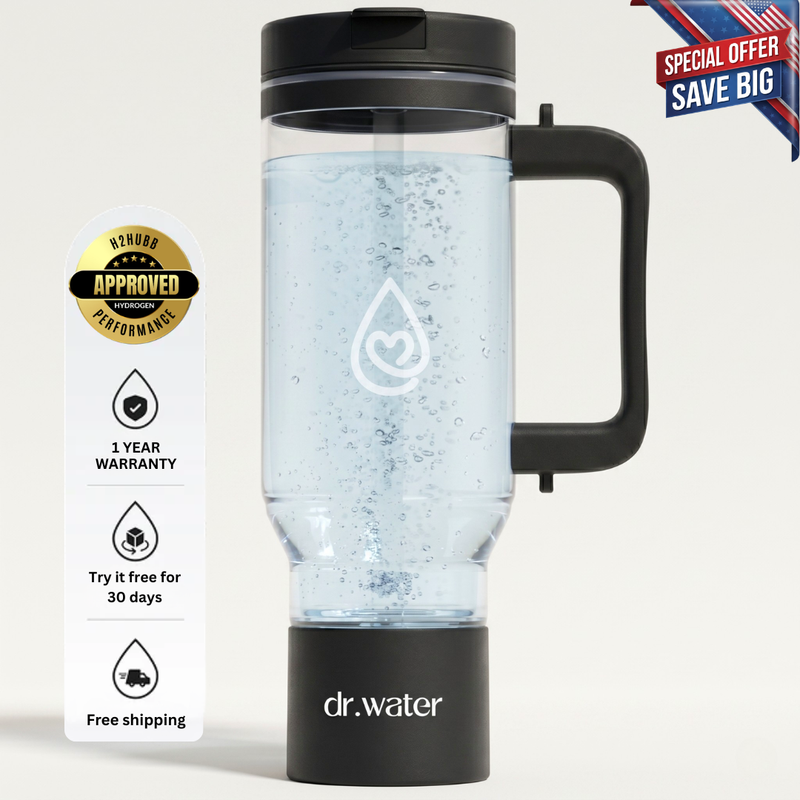
A hydrogen generator you leave at home because it's bulky isn't doing anything for you. The Hydrator Max is built to fit a standard cup holder and travel in a bag without feeling like carrying a second water bottle. That's what portable is supposed to mean.

Why portability is a design constraint, not an afterthought
A hydrogen generator only works if you actually use it. If it's too bulky for a car cup holder, too heavy for a gym bag, or too awkward for airport security, it ends up sitting on a counter instead of coming with you.
We treated portability as a real engineering constraint from the start, not something to fix after the internals were locked in.
We treated portability as a real engineering constraint from the start, not something to fix after the internals were locked in.
What fits in a cup holder and what doesn't
Standard car cup holders run roughly 2.5 to 3 inches in diameter. A lot of hydrogen generators, especially ones built around a wide internal chamber, simply don't fit that footprint.
- Fits: standard car cup holders, most gym bag side pockets, backpack water bottle sleeves
- Doesn't reliably fit: narrow bike bottle cages, some airline seat-back pockets on smaller aircraft
- Design goal: the same footprint as a standard reusable water bottle, not a specialty device
Where the weight actually comes from
Most of a hydrogen bottle's weight is the electrolysis hardware, the battery, the plate, and the sealed chamber, not the outer shell. That's true of ours too. You can't make the electrode or the battery weightless.
Using a food-grade Makrolon body instead of a metal outer shell keeps overall weight down without touching the internal components that actually matter for hydrogen output. It's a lighter material doing the job a metal shell would, without the added weight.
Travel scenarios that actually matter
| Scenario | What Matters Most | How It Holds Up |
|---|---|---|
| Daily commute, car cup holder | Diameter fit | Fits standard cup holders |
| Gym bag or backpack | Weight, won't leak sideways | Sealed design, travels upright or on its side |
| Carry-on air travel | Empty before security, refill after | Standard bottle-style handling |
| Desk at work | Doesn't need constant charging | 30+ cycles per charge, USB-C top-off |
What we didn't compromise on for the sake of size
It would be easy to hit a lighter weight by shrinking the electrode plate or the battery, but that directly cuts hydrogen output and cycle count. We kept the 4,500 mAh battery and full-size platinum-plated titanium plate, and optimized the shell and layout around them instead.
That tradeoff shows up in a lot of ultra-light generators on the market: a smaller footprint that turns out to mean a smaller plate, a smaller battery, or both. A lighter number on the spec sheet isn't automatically a better bottle if it came from cutting the parts that do the actual work.
If you're comparing bottles for travel, ask for the actual weight in grams or ounces and the battery capacity together, not separately. A bottle that's lighter only because the battery is smaller will need charging far more often on the road, which defeats the point of buying something portable in the first place.
A bottle that's lighter only because the battery is smaller will need charging far more often on the road.
FAQ
Will the Hydrator Max fit in a standard car cup holder?
Yes, it's sized to fit standard cup holders, the same footprint as a typical reusable water bottle.
Is it heavy compared to a regular water bottle?
It's heavier than an empty plastic bottle because it houses real electrolysis hardware, a battery, and a sealed glass chamber, but it's built to still feel manageable to carry daily, not like a piece of lab equipment.
Can I take it through airport security?
Like any water bottle, empty it before security and refill on the other side. The battery is a standard lithium-ion pack similar to what's in most portable electronics.
Does the smaller size mean less hydrogen output?
No, we kept the full-size electrode plate and battery and built the portable footprint around them, so output wasn't the tradeoff for portability.
A bottle that stays home doesn't help you. The Hydrator Max is built to actually come with you, and the 30-day risk-free trial gives you a month to prove that to yourself before you're locked in.