TLDR
Most people ask this question backwards. There is no single official minimum, but a lot of hydrogen-rich water research clusters above 1 ppm dissolved hydrogen, which is already close to what an open-air bottle can produce at all. If your bottle tops out around 0.5 ppm, you are likely under the range most protocols actually used.

Why water has a saturation ceiling
Hydrogen gas has a natural limit for how much will dissolve into water at normal atmospheric pressure, sitting around 1.6 ppm. That ceiling exists no matter how good your electrode is or how long you run it, because the water itself can only hold so much.
This is the part most marketing skips. A bottle can run a strong current and still land under 1 ppm simply because it is open to the air and unpressurized.
What ranges research protocols used
Early studies on hydrogen-rich water vary a lot in method, but a large share of them worked in the range where dissolved hydrogen sat between roughly 0.5 and 1.6 ppm, since that matched what tablets or standard generators could achieve at the time.
Newer work using sealed, pressurized generation has been able to test higher concentrations, up toward several parts per million, though this area is still developing and results vary by study design.
None of this means a specific ppm cures anything. Concentration is the variable researchers actually manipulate, so it is worth knowing what number your own water is really carrying.
Concentration is the variable researchers actually manipulate. That is the number worth knowing about your own water.
Dose ranges by goal
| Goal | Typical dissolved H2 range | Why |
|---|---|---|
| Casual daily hydration | 0.5 to 1.6 ppm | Achievable with open-air or tablet methods |
| Matching higher-dose protocols | 1.6 to 10 ppm | Requires sealed, pressurized electrolysis |
| Hydrator Max peak output | 10 ppm (10,000 ppb) | Measured on-device with SPE/PEM and consecutive cycling |
Why more cycles changes the outcome
A single short electrolysis run in an unsealed container is not the same process as multiple consecutive cycles in a pressurized chamber. Each additional cycle in a sealed system pushes more dissolved gas into the water before it has a chance to escape.
- Open-air electrolysis: gas escapes as fast as it forms, capping the total
- Sealed single cycle: some gas stays dissolved, but pressure is limited
- Sealed consecutive cycling: pressure builds, allowing concentration to climb well past 1.6 ppm
Mistakes that waste your dose
Even a bottle capable of a high peak concentration will underperform if you handle it wrong afterward.
- Letting the bottle sit capped-but-not-sealed after the cycle finishes
- Pouring the water into an open cup and leaving it before drinking
- Mixing in powders or electrolytes before running the electrolysis cycle instead of after
- Using tap water with heavy mineral content instead of RO, distilled, or filtered water
Dissolved hydrogen gas escapes water quickly once exposed to air, so volume does not substitute for concentration in any meaningful way.
FAQ
Is there an official minimum therapeutic ppm for hydrogen water?
There is no single regulatory threshold. What exists is a cluster of research using dissolved hydrogen roughly between 0.5 and 1.6 ppm, with newer protocols testing higher concentrations using pressurized generation.
Why can't most bottles get above 1.6 ppm?
That is close to the natural saturation point for hydrogen gas dissolving into water at normal atmospheric pressure. A sealed, pressurized chamber is needed to push past it.
Does drinking more low-concentration water make up for a lower ppm?
Not really. Dissolved hydrogen gas escapes water quickly once exposed to air, so volume does not substitute for concentration in any meaningful way.
How do I know what concentration I am actually drinking?
Look for a device with an on-device ppb or ppm readout rather than a printed claim, so you can see the number your specific bottle of water produced.
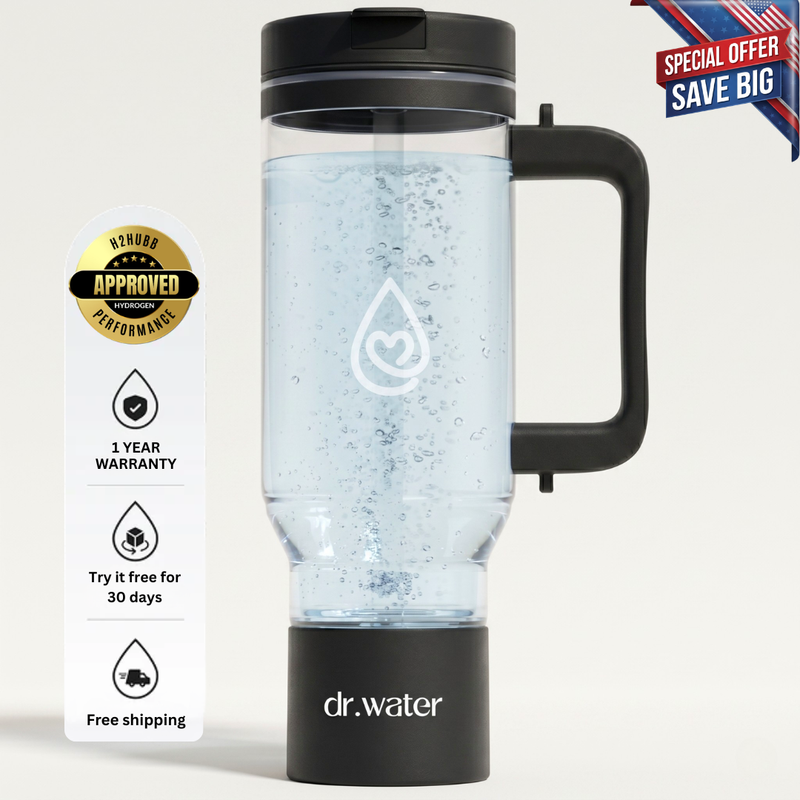
The Hydrator Max uses a pressurized borosilicate chamber and SPE/PEM electrolysis to reach a measured 10,000 ppb peak, and it comes with a 30-day risk-free trial if you want to compare it against what you use now.
⚕️ Clinicians' Choice
2,033 clinicians share Dr. Water on VerifiedMD without compensation.