TLDR
Runners, lifters, and endurance athletes generally want to be at the higher end of the dissolved hydrogen range, closer to several ppm, and timed around training rather than sipped randomly through the day. A weak 1 ppm bottle asks you to drink a lot more water than most people actually want mid-workout.

Why athletes are a different use case
A casual drinker sipping hydrogen water across a workday has hours to consume a low concentration and still take in a meaningful amount over time. An athlete drinking around a training session usually has a much shorter window.
That compressed window is why concentration matters more here than it does for casual daily use.
You need the dose in less volume, in less time, without chugging a liter before a run.
How to time doses around training
Most people default to drinking hydrogen water whenever they remember, but training days benefit from a bit more structure.
| Window | Purpose | Practical note |
|---|---|---|
| 30 to 45 min pre-training | Getting a dose in before exertion begins | Small volume, higher concentration works better than a large slow sip |
| During long sessions | General hydration alongside electrolytes | Keep hydrogen water and electrolyte mix separate, combine after electrolysis |
| Within an hour post-training | Recovery-focused hydration | Many athletes prioritize this window most |
What early research looked at
A handful of small studies in athletic populations have looked at hydrogen-rich water around training, generally using dissolved hydrogen in the roughly 1 to 2 ppm range over the course of the study period. Findings across this early work are mixed and study sizes tend to be small.
This is still an early area of research. Treat any specific outcome claim with caution, and think of hydrogen water as one part of a broader hydration and recovery routine, not a substitute for sleep, protein, or training load management.
Volume and concentration together
Concentration alone does not tell the whole story. Total dissolved hydrogen intake depends on both how strong the water is and how much of it you actually drink.
- 500 ml at 10 ppm delivers more total dissolved hydrogen than 1.5 liters at 1 ppm
- Smaller, more concentrated servings are easier to fit around a workout than large volumes
- Concentration drops the longer water sits after the cycle, so timing your drink close to the cycle matters
500 ml at 10 ppm delivers more total dissolved hydrogen than 1.5 liters at 1 ppm.
Picking gear that can hit the number
Not every bottle marketed to athletes can actually reach a useful concentration in a reasonable volume. A few things worth checking before you buy one for training use.
- On-device ppb readout so you can see the actual number instead of a label claim
- Sealed, pressurized chamber, since open-air units stall around 1.6 ppm
- Battery life that can survive a training block without daily charging
- A bottle body that can handle being tossed in a gym bag
FAQ
How much ppb hydrogen water should athletes aim for?
Given the shorter drinking window around training, athletes generally benefit from higher concentration water so they can get a meaningful dose in a smaller serving rather than needing to drink large volumes.
Is it better to drink hydrogen water before or after a workout?
Both windows show up in early research and in athlete routines. Many people prioritize a small pre-training serving and a recovery-focused serving within an hour after finishing.
Can I mix electrolyte powder into my hydrogen water bottle?
Run the electrolysis cycle on plain RO, distilled, or filtered water first, then mix in powders or electrolytes afterward. Electrolyzing a mix directly is not recommended.
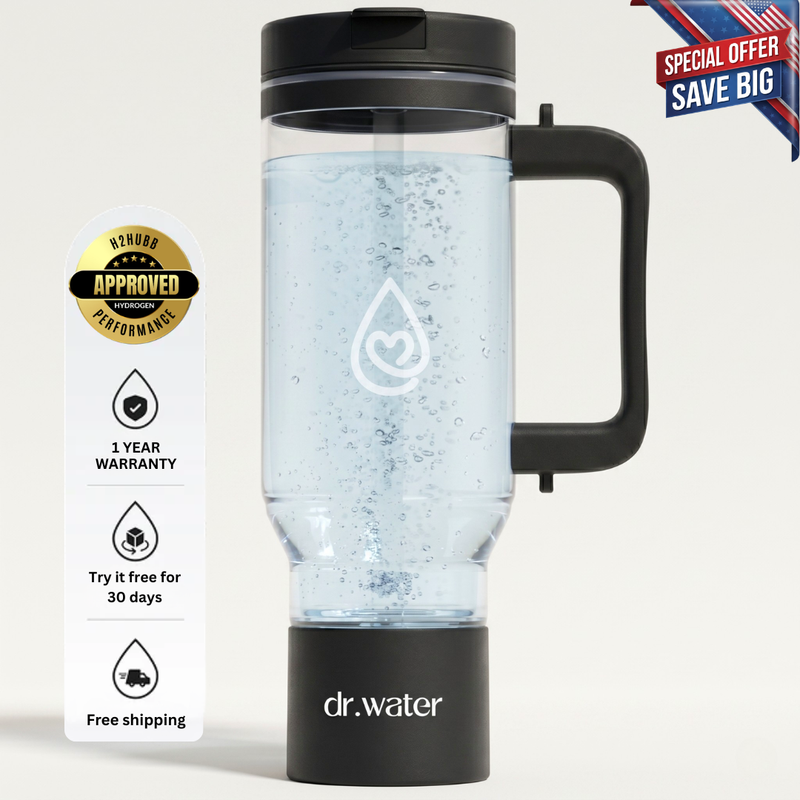
Does the Hydrator Max hold up to daily training use?
It runs on a 4500 mAh battery good for 30 plus cycles per charge, with a food-grade Makrolon body and a 60 second UV self-clean cap, built for regular daily use.
If training is part of your routine, the Hydrator Max hits a measured 10,000 ppb peak and ships with a 30-day risk-free trial so you can test it against your current bottle.
⚕️ Clinicians' Choice
2,033 clinicians share Dr. Water on VerifiedMD without compensation.