TLDR
Henry's Law says the amount of gas that dissolves into a liquid is proportional to the pressure above it. Run electrolysis in an open cup and hydrogen escapes as fast as it forms, capping you around 1.6 ppm. Seal the chamber and raise the pressure and you can push dissolved hydrogen much higher, which is how a device reaches 10,000 ppb.

What Henry's Law actually says
Henry's Law is a straightforward gas solubility rule. It states that the amount of a gas that dissolves into a liquid at a given temperature is directly proportional to the partial pressure of that gas above the liquid.
In plain terms, more pressure pushes more gas into the water, and less pressure lets gas escape. This is the exact same reason a sealed soda can stays fizzy and a poured glass goes flat.
More pressure pushes more gas into the water, and less pressure lets gas escape.
Open cup vs. sealed chamber
Run electrolysis in an open container and hydrogen bubbles form and immediately begin escaping into the air, because there is nothing above the water holding them in.
| Setup | What happens to the gas | Typical ceiling |
|---|---|---|
| Open cup or unsealed bottle | Escapes to air as it forms | Roughly 1.6 ppm |
| Sealed chamber, single cycle | Some gas stays dissolved under modest pressure | Above open-air, still limited |
| Sealed, pressurized, consecutive cycles | Pressure builds with each cycle, forcing more gas to dissolve | Up to 10,000 ppb measured on-device |
Why 1.6 ppm is the open-air ceiling
At normal atmospheric pressure and room temperature, water reaches a natural saturation point for dissolved hydrogen gas around 1.6 ppm. Past that point, any additional gas produced by electrolysis simply bubbles out rather than dissolving.
This is why open-air generators, no matter how strong their electrode or current, cannot get past that number.
It is a limit set by the liquid, not the equipment.
It feels intuitive that a stronger current should mean more hydrogen in the water. In an open system that is not true past the saturation point. Extra current just produces gas that escapes unused.
What consecutive cycling does
Inside a sealed chamber, each electrolysis cycle adds pressure before the next one runs. That rising pressure is what allows dissolved hydrogen to climb well past the 1.6 ppm open-air ceiling.
- Cycle 1 builds initial dissolved gas and starts raising chamber pressure
- Each following cycle works against higher starting pressure, pushing concentration further
- The process continues until the device reaches its measured peak, in our case 10,000 ppb
How the pressure is kept safe
Pressurizing a chamber safely requires the right materials and a way to manage that pressure once the cycle ends. Our chamber is pressurized borosilicate glass inside a food-grade Makrolon body, and waste gas produced during electrolysis, like chlorine or ozone, is vented out rather than left to dissolve into your water.
None of this works with tap water that has not been filtered. Stick to RO, distilled, or filtered water, and never electrolyze a mix that already has salts or powders added.
FAQ
What is Henry's Law in simple terms?
It is the physics rule stating that the amount of gas dissolved in a liquid depends on the pressure of that gas above the liquid. More pressure means more gas can dissolve.
Why can't an open cup of water reach high hydrogen concentration?
Because there is no pressure holding the gas in, hydrogen bubbles escape into the air as fast as electrolysis produces them, capping dissolved concentration around 1.6 ppm.
Is a sealed, pressurized bottle actually better for ppm?
Based on Henry's Law, yes. Sealing the chamber and running consecutive cycles is the mechanism that allows dissolved hydrogen to exceed the open-air saturation limit.
What keeps the extra gas produced during electrolysis from being unsafe?
The SPE/PEM electrolysis process vents waste gas like chlorine and ozone out of the chamber instead of letting it dissolve into the water alongside the hydrogen.
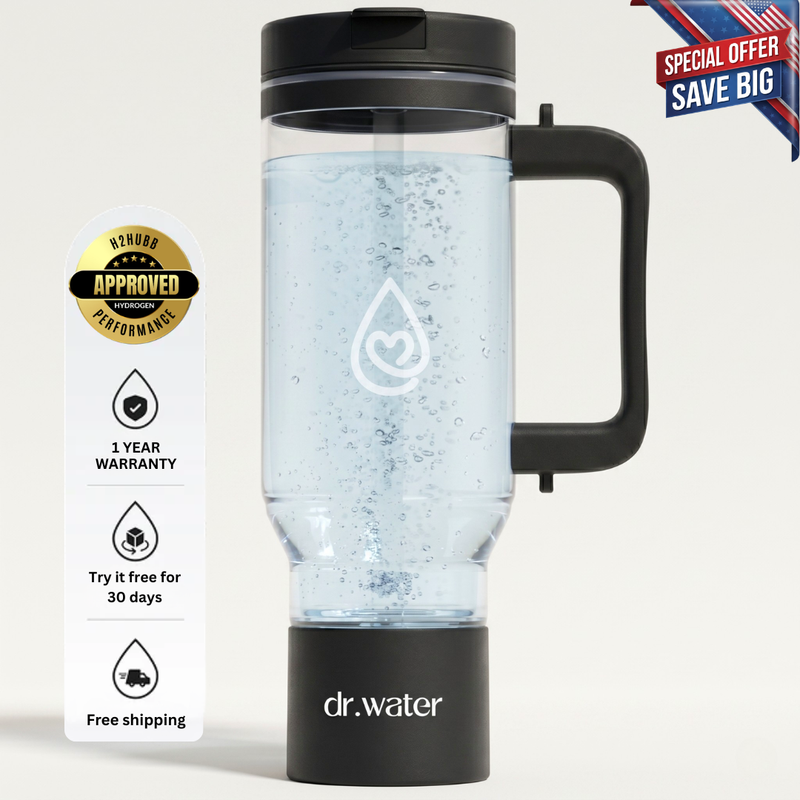
The Hydrator Max uses this exact sealed, pressurized, consecutive-cycle approach to reach a measured 10,000 ppb peak, and it ships with a 30-day risk-free trial.
⚕️ Clinicians' Choice
2,033 clinicians share Dr. Water on VerifiedMD without compensation.