TLDR
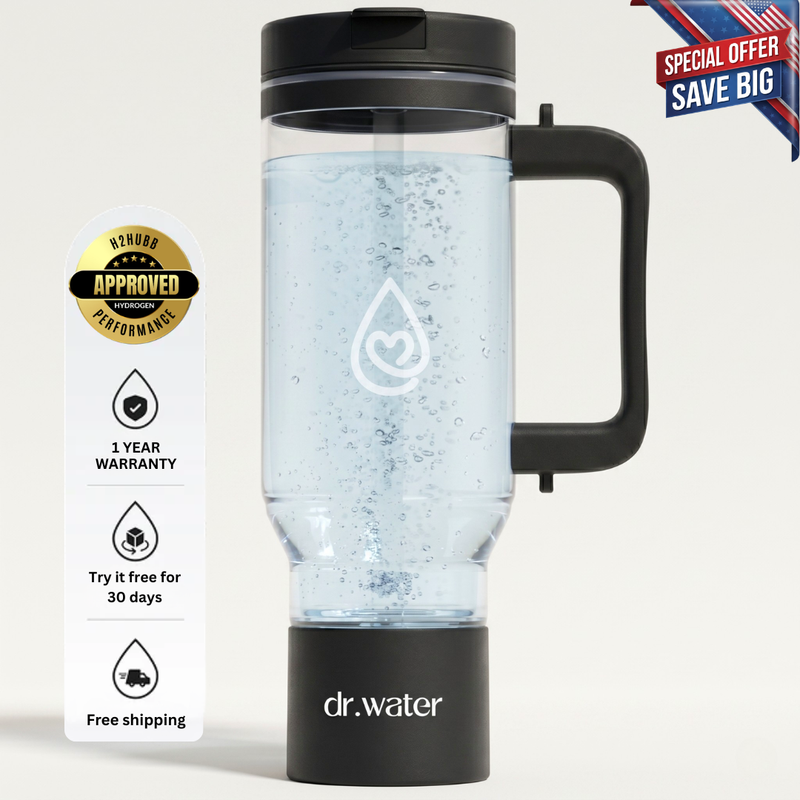
The Hydrator Max runs on a 4,500 mAh lithium-ion battery charged over USB-C, good for 30+ electrolysis cycles per charge. That's the difference between topping off a battery once every couple weeks versus every couple days, and USB-C means you're not hunting for a proprietary cable.

Why battery choice affects your hydrogen dose
Electrolysis takes real current. Splitting water molecules isn't a low-power task. A weak or degraded battery can't sustain the current a full cycle needs, and the cycle either runs short or the PPB output drops.
This is where cheap battery packs show their limits fastest. They can start a cycle fine but sag under sustained load, especially as they age.
A weak or degraded battery can't sustain the current a full cycle needs. The cycle either runs short, or the PPB output drops.
How lithium-ion compares to standard batteries
- Standard NiMH or generic packs: lower energy density, sag under sustained load, degrade faster with daily charge cycles
- Lithium-ion: higher energy density, holds voltage steady through a full cycle, built for hundreds of charge cycles
- Lithium-ion also handles partial charging better, you don't need to fully drain it before topping off
What 4,500 mAh actually gets you
The Hydrator Max's 4,500 mAh lithium-ion battery is rated for 30+ full electrolysis cycles on a single charge. In daily use, that's roughly a month of drinking hydrogen water before you plug it in again.
4,500 mAh, 30+ cycles on a single charge, roughly a month of daily use before you plug it in again.
| Battery | Capacity | Approx. Cycles per Charge |
|---|---|---|
| Hydrator Max (lithium-ion) | 4,500 mAh | 30+ |
| Typical low-cost hydrogen bottle | Often unlisted or under 2,000 mAh | Often single digits before recharge |
A lot of listings for hydrogen bottles skip battery capacity entirely. If a spec sheet won't tell you mAh or cycle count, ask directly. It's a fair question and a reasonable seller should have the answer.
Why USB-C over a proprietary cable
USB-C is the plug already in your bag for your phone, laptop, or headphones. We didn't see a reason to force a proprietary cable you'll inevitably lose on a trip.
It also charges fast enough that a lunch-break top-off is realistic. You don't need to plan around an overnight charge the way some older battery designs require.
Getting the most cycles per charge
Battery longevity, like the electrode and seals, benefits from using RO, distilled, or filtered water. Scale buildup makes the electrolysis cell work harder, which pulls more current per cycle than it should need.
Storing the bottle at a partial charge rather than always running it to zero is a small habit that helps any lithium-ion battery last longer over years of use, not just this one.
Plug in over USB-C, let it charge fully, then use it normally until it's low again. There's no special routine required, and no need to babysit the charge percentage the way older nickel-based batteries sometimes demanded.
FAQ
How many hydrogen cycles do I get per charge?
The Hydrator Max is rated for 30+ full electrolysis cycles on one charge of its 4,500 mAh battery, which covers roughly a month of typical daily use before recharging.
Can I use any USB-C cable to charge it?
Yes, any standard USB-C cable works. There's no proprietary charger to track down or replace.
Does the battery degrade over time like a phone battery?
Lithium-ion batteries do lose some capacity over hundreds of charge cycles, that's true of any lithium-ion device. Using RO or filtered water reduces unnecessary strain on the electrolysis cell, which helps the battery last as long as it's built to.
What happens if the battery is low mid-cycle?
The device is designed to sustain a full cycle within its rated charge range. If you're regularly seeing incomplete cycles well before the 30-cycle mark, that's worth reaching out to support about.
A 4,500 mAh battery and USB-C charging mean the Hydrator Max is ready when you are, not stuck on a charger. It ships with a 30-day risk-free trial, so put it through a real month of use before you decide.