TLDR
1,500 ppb and 10,000 ppb are not two brands doing the same thing differently. Most bottles cap near 1,500 ppb because that is close to what hydrogen gas will dissolve into water at normal pressure. Reaching 10,000 ppb (10 ppm) takes a sealed, pressurized chamber, which is why we measure our peak on-device rather than print it on a box.

PPB and PPM are the same math
Parts per billion and parts per million measure the same thing at different scales. One ppm equals 1,000 ppb, so a 1,500 ppb reading is 1.5 ppm, and 10,000 ppb is 10 ppm. Brands switch labels depending on which number sounds bigger.
Once you convert everything to the same unit, comparing bottles gets a lot simpler. A device claiming 1.5 ppm and one claiming 1,500 ppb are the same product wearing two outfits.
A device claiming 1.5 ppm and one claiming 1,500 ppb are the same product wearing two outfits.
Why most bottles stall near 1,500 ppb
Hydrogen gas has a saturation point in water at normal atmospheric pressure, roughly 1.6 ppm. Run electrolysis in an open cup or an unsealed bottle and you will hit that wall no matter how long you run the current.
That ceiling is not a design flaw on those products. It is physics. Water simply will not hold more dissolved gas at one atmosphere of pressure, so anything claiming a big number from an open-air unit deserves a second look.
The dose ranges you'll actually see
Hydrogen water research uses a wide range of concentrations. The number quoted usually depends on how the water was generated.
| Category | Dissolved H2 | How it is usually reached |
|---|---|---|
| General hydration support | 0.5 to 1.6 ppm | Tablets or standard open-air bottles |
| Higher-dose protocols | 1.6 to 10 ppm | Sealed, pressurized electrolysis chambers |
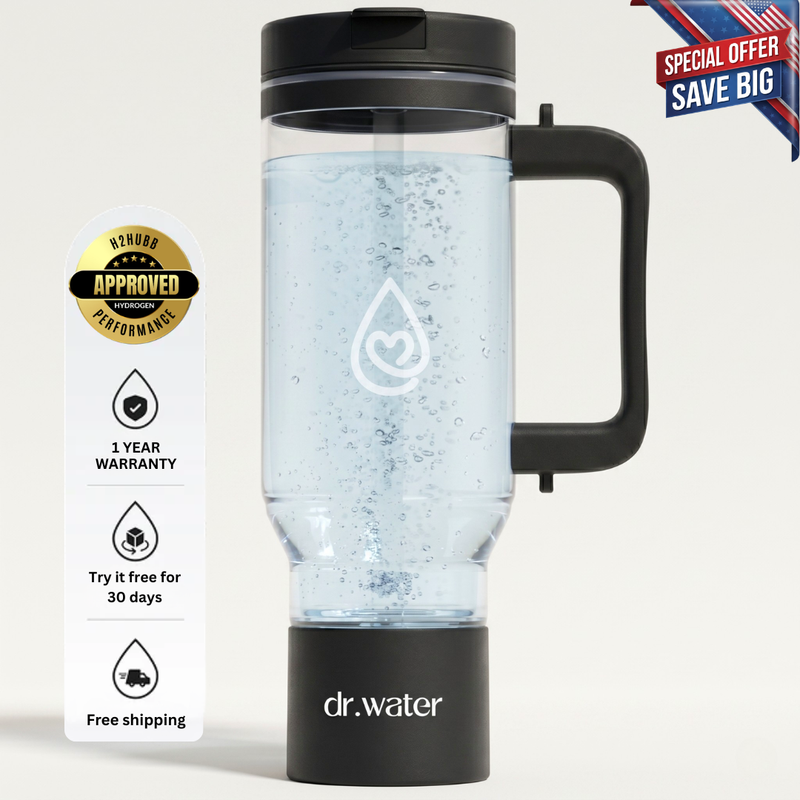
| Hydrator Max peak | 10 ppm (10,000 ppb) | SPE/PEM electrolysis in a pressurized borosilicate chamber, measured on-device |
Our bottle reaches its peak by running additional electrolysis cycles back to back inside a sealed chamber. That is what lets it climb past the open-air ceiling.
Why concentration beats volume
You cannot make up for a weak concentration by drinking more of it. Dissolved hydrogen gas is small and mobile, and it starts leaving the water the moment you break the seal or expose it to air.
- A liter of 1.5 ppm water carries less total dissolved gas than 300 ml of 10 ppm water
- Off-gassing accelerates once the bottle is opened repeatedly
- Drinking promptly after the cycle finishes preserves more of the dose than letting it sit
A liter of 1.5 ppm water carries less total dissolved gas than 300 ml of 10 ppm water.
How to check what you're actually getting
A printed number on packaging is a claim. What matters is whether the device can show you a real reading and whether the gas the electrolysis process creates besides hydrogen is vented out or left to dissolve alongside it.
- Look for an on-device ppb or ppm readout instead of a box claim
- Confirm the electrolysis method: SPE/PEM with a platinum-plated electrode is the standard to look for
- Check that waste gas (chlorine, ozone) is vented out instead of dissolving into your water
- Verify the chamber material can handle the pressure needed to push past 1.6 ppm
FAQ
Is 10,000 ppb the same as 10 ppm hydrogen water?
Yes. Ppb and ppm are the same measurement at different scales, and 10,000 ppb converts directly to 10 ppm.
Why do most hydrogen water bottles only claim 1,000 to 1,600 ppb?
That range sits near the natural saturation point for hydrogen gas dissolving into water at normal pressure. Going higher requires a sealed, pressurized chamber during electrolysis.
Does a higher ppb number always mean a better result?
Concentration determines how much dissolved gas is actually in the water you drink. A higher verified number means you can get a meaningful dose from less volume, rather than needing to drink large amounts of weak water.
How does the Hydrator Max reach 10,000 ppb?
It uses SPE/PEM electrolysis with a platinum-plated electrode inside a pressurized borosilicate glass chamber, running consecutive cycles and measuring the peak concentration on-device.
If you want to see the number for yourself instead of taking a label's word for it, the Hydrator Max ships with a 30-day risk-free trial so you can test it against whatever you are using now.
⚕️ Clinicians' Choice
2,033 clinicians share Dr. Water on VerifiedMD without compensation.