TLDR
Molecular hydrogen is the gas H2, two hydrogen atoms bonded together. Researchers have tested it as an antioxidant and a signaling molecule since 2007. Human trials are small and short, and benefits are modest. It reaches the body by inhalation, as hydrogen-rich water, or through tablets that release the gas in water.
What molecular hydrogen is
Molecular hydrogen is the gas H2. It is two hydrogen atoms joined by a bond. It has no color or smell, and it is the smallest molecule known. The small size is the reason it escapes from water so fast.
It is easy to mix up with other things named hydrogen. Here is how they differ.
| Term | What it is | Not to be confused with |
|---|---|---|
| Molecular hydrogen (H2) | A dissolved or free gas made of two hydrogen atoms | The hydrogen atoms inside H2O |
| Hydrogen ions (H+) | Charged particles that set a liquid's pH | H2 gas. Alkaline water is about pH, not about H2. |
| Hydrogen peroxide (H2O2) | A different compound that contains oxygen | H2. It is an oxidizer, not a gas in water. |
For the drinking-water side of the story, read our hub on what hydrogen water is. For the contrast with alkaline water, see hydrogen water vs ionized water.
Why researchers study molecular hydrogen
The modern interest traces to a 2007 Nature Medicine paper by Ohsawa and colleagues. It reported that hydrogen reduced the hydroxyl radical, a harmful reactive oxygen species, in cultured cells. It also used a rat model of brain ischemia and reperfusion, where inhaled hydrogen gas reduced injury.
Later reviews, such as this 2014 review in Pharmacology and Therapeutics, describe the field as hydrogen medicine and discuss possible antioxidant and anti-inflammatory roles. The idea is that H2 may act as a selective antioxidant and as a signaling molecule.
Keep the limit in mind. Most of that early work used cells, animals and gas inhaled at set doses. It does not show that a glass of hydrogen water does the same in people. That is a question for human trials, which are covered below.
How molecular hydrogen is delivered
The 2026 review in the Journal of Clinical Biochemistry and Nutrition separates the main routes and points out that studies often mix them together. The routes are not equal in dose or in evidence.
| Route | What it is | Notes |
|---|---|---|
| Inhaled gas | H2 breathed in at a controlled concentration | Used in clinical research. Not a home-use item. |
| Hydrogen-rich saline | H2 dissolved in saline, mostly for injection in studies | A research and medical setting. |
| Hydrogen-rich water | H2 dissolved in drinking water | Made by bottles, machines, pressure filling or tablets. See the hub guide. |
| Tablets and sticks | Magnesium that reacts with water and releases H2 | Covered in the next section. |
| Baths and topical use | H2 in bath water or applied to skin | Small skin studies. See the benefits guide. |
Molecular hydrogen tablets: how they work
Most molecular hydrogen tablets contain magnesium. When the tablet meets water, magnesium reacts with it, which gives magnesium hydroxide and hydrogen gas. The tablet fizzes as H2 comes off.
The 2026 review in the Journal of Clinical Biochemistry and Nutrition gives the reaction as Mg + 2H2O gives Mg(OH)2 + H2 and calls the by-product benign. It adds that too much magnesium hydroxide can raise alkalinity, so pH needs control for safety and consistency.
A 2021 formulation study in Pharmaceuticals examined magnesium-containing effervescent tablets for oral delivery. It tested how different fillers changed how fast the tablet broke down and generated hydrogen. The point for buyers: tablet design changes performance, so two tablets with the same label can behave differently.
What to check on a hydrogen tablet
- The amount of H2 released, and how it was measured.
- How much water you dissolve it in. The level depends on the volume.
- The full ingredient list, including the magnesium form and any fillers.
- Whether the maker says to drink right away. Hydrogen leaves the glass quickly.
Our comparison of hydrogen tablets and water bottles sets out the trade-offs, and this tablet guide covers benefits and side effects.
What human trials of molecular hydrogen report
Most human trials use hydrogen-rich water. Below are examples I opened on PubMed or PubMed Central, with their size and design, so you can judge them.
| Study | Design | Reported result | Caveat |
|---|---|---|---|
| Botek et al., 2019 | 12 men, randomized, double-blind placebo crossover; 600 ml within 30 min before exercise | Lower blood lactate at higher intensities; lower perceived effort at the top step | 12 participants; one session |
| Sládečková et al., 2026 | 12 finswimmers, double-blind crossover; 0.9 ppm for 3 to 4 days | 400 m trial 0.6% faster; sprints, lactate and effort not different | 12 athletes; short; authors call the gain modest |
| LeBaron et al., 2020 | 60 people with metabolic syndrome, randomized, double-blind, placebo-controlled; 24 weeks | Reported lower cholesterol, glucose and HbA1c, plus better inflammation and redox markers | Small; needs replication |
| Kajiyama et al., 2008 | 36 people with type 2 diabetes or impaired glucose tolerance, double-blind crossover; 900 ml/day for 8 weeks | Lower modified LDL, small dense LDL and urinary 8-isoprostanes | Small; some outcomes were trends only |
| Mizuno et al., 2017 | 26 volunteers, double-blind crossover; 600 ml/day for 4 weeks | Lower K6 score and resting sympathetic nerve activity | Small; self-report questionnaire |
| Li et al., 2024 (meta-analysis) | 6 studies, 76 healthy adults, exercise-induced oxidative stress | No effect on d-ROMs; antioxidant potential improved (SMD 0.29, P = 0.03) | Small pool; authors ask for more rigorous studies |
The 2026 review in the Journal of Clinical Biochemistry and Nutrition reviewed 72 relevant studies (18 in vitro, 28 animal, 26 human). It describes small samples, 4 to 12 week durations and inconsistent reporting of concentration. That inconsistency is why two studies on "hydrogen water" can mean very different doses.
For the full topic-by-topic read, see hydrogen water benefits. For a skeptical read, see is hydrogen water a scam.
What doses did trials use?
No standard dose exists. The table lists what the studies above report, so you can see the spread. Where I convert units, the arithmetic is my own and treats 1 ppm as 1 mg/L.
| Study | Reported dose | In mg/L or mg |
|---|---|---|
| Nakao et al., 2010 | 0.55 to 0.65 mM, magnesium stick, 8 weeks, 20 people, open label | About 1.1 to 1.3 mg/L |
| Sládečková et al., 2026 | 0.9 ppm for 3 to 4 days | 0.9 mg/L |
| LeBaron et al., 2020 | More than 5.5 mmol H2 per day for 24 weeks | More than about 11 mg per day |
| Zanini et al., 2021 | 0.5 L per day at 15 ppm for 6 months, 40 older adults, as the authors report | About 7.5 mg per day |
The levels span more than ten-fold, and the studies measured different outcomes. That is why I do not give a target. The honest answer to "how much molecular hydrogen should I take" is that research has not settled it.
If you are comparing bottles, our dose math article walks through the per-glass arithmetic, and this guide explains how to measure a level.
Is molecular hydrogen safe?
In the studies it reviews, the 2026 review in the Journal of Clinical Biochemistry and Nutrition found no clinically meaningful change in liver, kidney, blood or ECG markers over 4 to 12 weeks. It also says long-term safety data are limited. Short trials show no clear harm, and that is as far as the evidence goes.
- Tablets add magnesium. If you have kidney disease or take magnesium-sensitive medicine, ask your clinician first.
- Some people get loose stools or stomach changes when they start. See hydrogen water side effects.
- Do not treat molecular hydrogen as a replacement for medical care.
- Inhaled hydrogen is a clinical research tool. This guide does not recommend home inhalation.
How to get molecular hydrogen from a bottle
A hydrogen water bottle makes H2 by electrolysis, so it gives a repeatable dose without magnesium. Whatever you use, a few habits matter more than the label.
- Use clean, filtered water. Cold or room temperature works best.
- Drink soon after the cycle. Hydrogen leaves the water within about 30 to 60 minutes.
- Keep the chamber clean. Mineral buildup is the top reason output drops.
- Check the claim. Ask for a ppb figure with a cycle time and a test method.
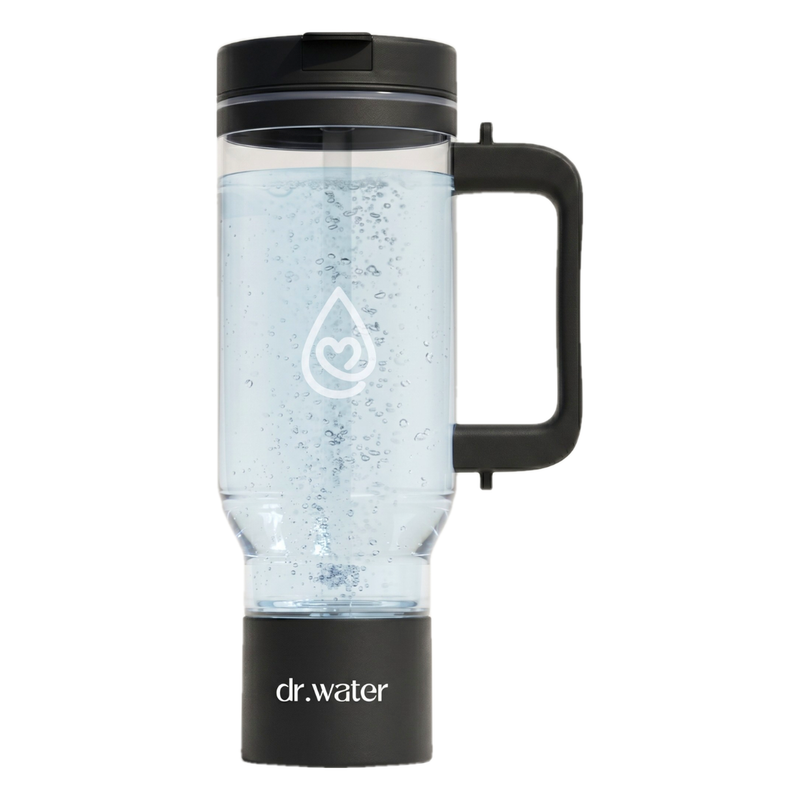
The Hydrator Max lists up to 10,000 PPB on its 10-minute cycle and about 3,000 PPB on the 5-minute cycle. Those are our figures, and the page links no independent dissolved-hydrogen report. See is 10,000 ppb real for how to test a figure. To compare bottles, read the buying guide and how to make hydrogen water at home.
Research on molecular hydrogen is real and early. Treat it as an add-on to good hydration, not a treatment.
FAQ
What is molecular hydrogen?
Molecular hydrogen is the gas H2, made of two hydrogen atoms. It is the smallest molecule known. In health research, it is tested as an antioxidant and signaling molecule, delivered by inhalation, in water or through tablets.
What are the benefits of molecular hydrogen?
Small trials report lower blood lactate during hard exercise, a small rise in antioxidant potential and some changes in metabolic and mood markers. Evidence is early and trials are short. It is not a treatment for any disease.
Do molecular hydrogen tablets work?
They release hydrogen when magnesium reacts with water. How much H2 you get depends on the tablet design and the water. A 2026 review notes that production methods give inconsistent dissolved levels across studies.
Are molecular hydrogen tablets safe?
Short trials found no clinically meaningful lab changes. Tablets add magnesium and can raise alkalinity. Ask your clinician if you have kidney disease or take medicine, and read the full ingredient list.
What is the difference between hydrogen water and molecular hydrogen?
Molecular hydrogen is the gas. Hydrogen water is one way to deliver it, by dissolving the gas in drinking water. Other routes are inhalation, saline and tablets.
Is molecular hydrogen the same as alkaline water?
No. Molecular hydrogen is dissolved H2 gas. Alkaline water changes pH, which depends on hydrogen ions. The two are different measures.
How much molecular hydrogen should I take?
No standard dose exists. Trials used levels from about 0.9 mg/L to more than 11 mg per day. Ask your clinician, and do not use hydrogen to replace treatment.
What is molecular hydrogen therapy?
It is a research term for medical use of H2 gas, hydrogen-rich saline or hydrogen-rich water in studies. It is not an established standard treatment, and long-term safety data are limited.
How long does molecular hydrogen stay in water?
Not long. The gas escapes quickly, so drinking within about 30 minutes is the usual advice. For the Hydrator Max, the product page says hydrogen stays strong for about 30 to 60 minutes.
If you want to read the Hydrator Max specs exactly as we list them, see the Hydrator Max product page.