TLDR
10,000 ppb is 10 ppm, or about 10 mg per liter of dissolved hydrogen. It is far above the 0.6 to 1.6 ppm that a 2026 review reports for electrolysis at normal pressure. Treat it as a claim until you see the method, the water, the cycle and the timing. Ours is a maker claim too: we link no lab report.
What 10,000 ppb actually means
PPB is parts per billion. One ppm is 1,000 ppb, so 10,000 ppb is 10 ppm. In water, 1 ppm is about 1 mg per liter, so this is about 10 mg of dissolved hydrogen gas per liter.
Hydrogen is a gas, and water holds very little of it. That is why the number matters and why it is hard to reach.
Can a bottle reach 10,000 ppb at all
The same review says higher values need extra constraints: pressurization, cold water, sealed or pressure-resistant containers, and fast measurement. It reports up to about 3 ppm under such conditions.
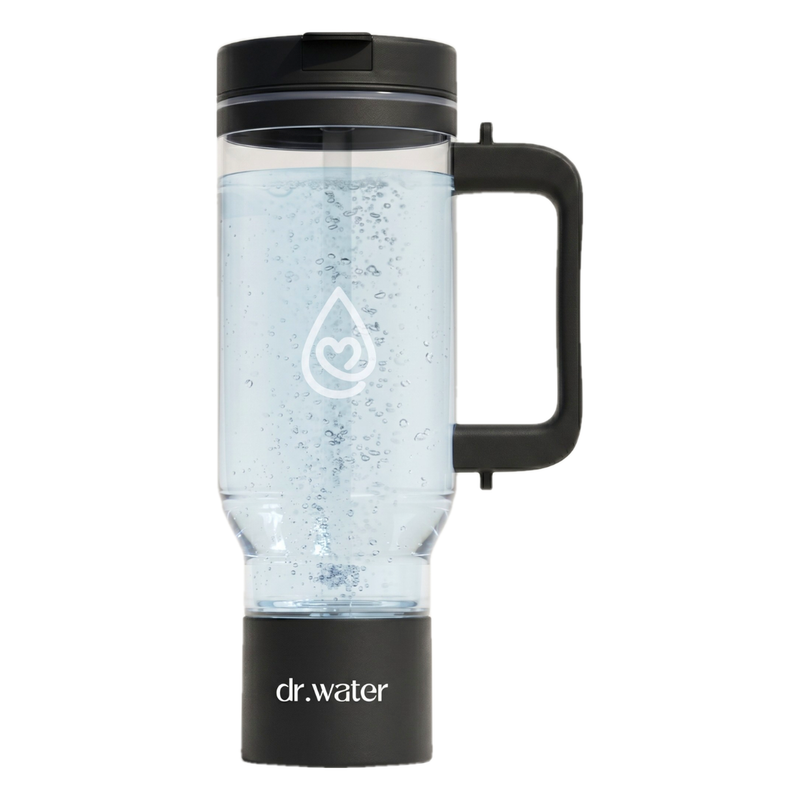
Makers of several bottles claim 5 to 10 ppm. Echo is the clearest case, because its page shows a gas chromatography report of up to 8.25 mg/L after a 20-minute cycle on distilled water. That report is the maker's own, and I have not checked it. I have no equal report for the Hydrator Max, so I cannot tell you its 10,000 ppb figure is verified. Our product page lists up to 10,000 ppb on a 10-minute cycle and about 3,000 ppb at 5 minutes.
Pressure is the key variable. A bottle that seals its chamber and builds pressure during electrolysis can hold more dissolved gas than an open cup can. The product page for the Hydrator Max does not describe pressure, so I cannot say how it works for our bottle.
How dissolved hydrogen is measured
A 2025 review in Advanced Science describes the main ways to detect hydrogen in a solution. The table lists three of them.
| Method | How it works | What to watch |
|---|---|---|
| Gas chromatography | A water sample goes through a lab instrument that separates and counts hydrogen gas | Needs a lab. The sample must be sealed fast, or hydrogen escapes first. |
| Electrochemical sensor | A probe in the water reads hydrogen from an electrical signal | Fast, but the probe needs calibration. |
| Methylene blue and colloidal platinum | Hydrogen turns the blue dye clear in a titration; the drops used at home work this way | Gives a rough number, and results depend on how carefully you count drops. |
For the drops method step by step, read how to verify PPB with H2 Blue drops.
Why two bottles with the same claim can read differently
- Cycle time: Echo's page gives 6 ppm at 10 minutes and 8 ppm at 20 minutes. The Hydrator Max page gives about 3,000 ppb at 5 minutes and up to 10,000 ppb at 10 minutes.
- Water type: Echo's report used distilled water. Tap water with minerals may give a different reading.
- Time after the cycle: Dr. Water's page says hydrogen stays strong for about 30 to 60 minutes. A reading at minute 40 is lower than one at minute 1.
- Open or closed container: an open cup lets gas escape as you measure.
- The meter: different methods give different numbers on the same glass.
The same bottle can read two very different numbers depending on when and how you measure.
How to read a lab report, with two real examples
Two bottles in this market show a lab figure next to a higher headline claim. Both are useful practice.
- Echo's Flask page: an H2 Analytics report dated January 16, 2025. It states gas chromatography, distilled water, 6.07 mg/L after a 10-minute cycle and up to 8.25 mg/L after 20 minutes. Method, water and cycle are all named.
- Piurify's Hydrogenator page: a lab figure of 4.1 mg/L from H2 Analytics, next to "up to 6,300 ppb" in its stacked modes. The page does not say which cycle was tested, so the two numbers cannot be compared.
Both reports are the makers' own, and I have not verified either one. They show what a complete report looks like and what a partial one leaves out.
What to check before you trust a ppb number
- Find the cycle time tied to the figure.
- Find the water type used in the test.
- Find the method and the lab or meter name.
- Find the time between the end of the cycle and the reading.
- Measure your own water with your own meter, right after the cycle.
Apply the same list to the Hydrator Max. Our page answers the first item and part of the fifth, and it does not answer the rest. I would rather say so here than let you assume.
What a fair test should look like
This is the test I would want to see for the Hydrator Max, and for any other bottle.
- Fill the bottle to its stated capacity (400 ml for the Hydrator Max) with the water type the maker recommends.
- Run one stated cycle length, such as the 10-minute cycle.
- Draw the sample right when the beep sounds, into a sealed vial.
- Have an independent lab analyze it with a named method.
- Repeat at least three times and publish every result, including the low ones.
We have not published that for the Hydrator Max. Until we do, read our 10,000 ppb as a claim, and compare it with what your own meter shows.
FAQ
Is 10,000 ppb the same as 10 ppm?
Yes. One ppm equals 1,000 ppb, so 10,000 ppb is 10 ppm, about 10 mg of dissolved hydrogen per liter of water.
Is 10,000 ppb hydrogen water real?
It is a number some makers claim. A 2026 review reports 0.6 to 1.6 ppm at normal pressure and about 3 ppm under controlled conditions. Higher claims need a stated method and a test report before you should rely on them.
How do I measure ppb in hydrogen water?
Labs use gas chromatography or electrochemical sensors. At home, people use methylene blue drops with colloidal platinum. Measure right after the cycle, because the gas leaves the water.
Does the Hydrator Max reach 10,000 ppb?
Dr. Water's product page lists up to 10,000 ppb on a 10-minute cycle and about 3,000 ppb on a 5-minute cycle. We do not link an independent dissolved-hydrogen test report, so treat the figure as the maker's claim.
Why do ppb readings vary between tests?
Cycle length, water type, time since the cycle ended, container and the meter all change the reading. Compare numbers only when those match.
If you want to read the Hydrator Max specs exactly as we list them, see the Hydrator Max product page.