TLDR
There's no single universal certification for "ozone-free" hydrogen bottles, so the phrase alone isn't proof of anything. Verify it yourself by asking about membrane isolation design, waste-gas venting, and whether independent lab testing backs up the claim.

In this guide
Why ozone comes up at all
Ozone is a natural possible byproduct of water electrolysis at the anode, alongside oxygen. In an open chamber with no isolation, some of that ozone can end up dissolved in your water or in the air you breathe when you open the bottle.
"Ozone-free" as a marketing phrase gets thrown around a lot. What actually verifies that claim is a different matter.
Ozone isn't automatically dangerous in tiny amounts. It's a naturally occurring gas. But it's not something you want building up in a sealed bottle you're about to drink from either, and that's the standard worth holding any device to.
What real verification looks like
Two separate things are worth checking, and they're not the same thing.
Design verification
Does the device have a membrane that isolates the anode reaction from the cathode reaction, and a waste-gas vent that routes any anode-side byproducts out of the system? That's a design question you can ask directly.
Output verification
Independent lab testing of the actual water and air output confirms whether the design works as intended in practice.
You don't need to run this testing yourself. You need to know it exists, and that a manufacturer is willing to show it to you when you ask.
Questions worth asking any manufacturer
- Does the device use a membrane to physically separate anode and cathode reactions?
- Is there a waste-gas vent, and where does it route byproduct gas?
- Has the water output been independently tested, and can you see that data?
- What's the material safety certification on the parts that touch water?
A quick evaluation checklist
| Check | Green flag | Red flag |
|---|---|---|
| Membrane isolation | Explicitly stated and explained | Vague or unmentioned |
| Waste-gas venting | Described with a clear exit path | No mention of where byproducts go |
| Water-contact materials | Named and certified (e.g. food-grade, BPA-free) | Unspecified plastic |
| Independent testing | Available on request | "Trust us" with no data |
How we handle this for the Hydrator Max
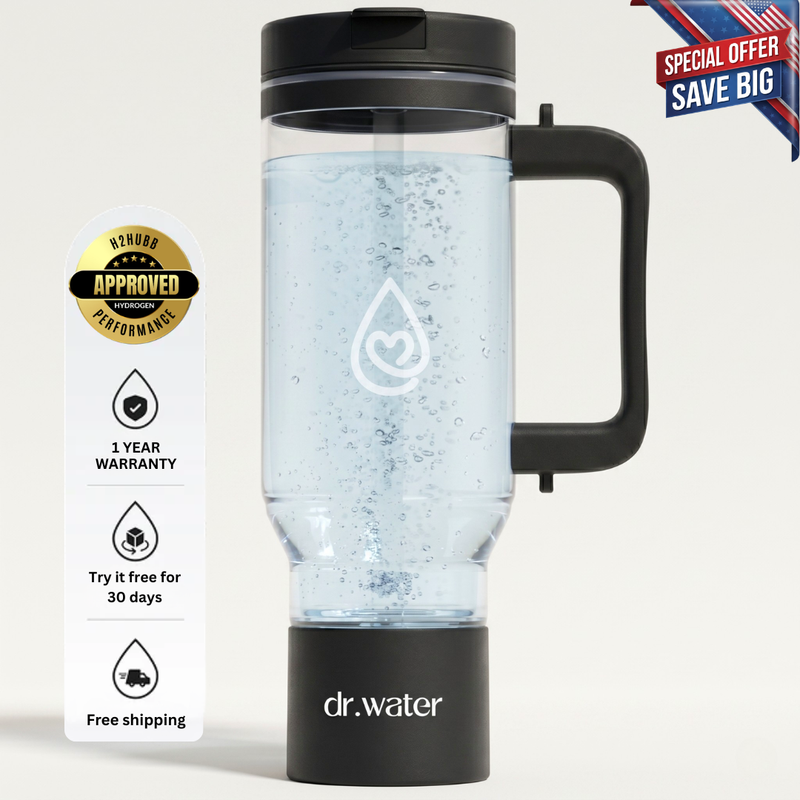
The Hydrator Max uses a certified SPE/PEM membrane and a waste-gas vent by design, with a food-grade Makrolon body and pressurized borosilicate glass inner chamber for the parts that touch water. That's the specific combination we stand behind, and it's the same set of criteria we'd tell you to check on any bottle, including ours.
We'd rather you evaluate us against a checklist than a slogan.
A slogan is easy to print on a box. A checklist is what actually tells you whether the engineering behind it holds up.
FAQ
Is 'ozone-free' a regulated claim?
Not in a way that's standardized across the industry. That's exactly why it's worth asking for design details (membrane isolation, venting) and independent output testing rather than taking the phrase at face value.
What should I ask a manufacturer to verify ozone safety?
Ask whether the device uses membrane isolation between anode and cathode reactions, whether there's a waste-gas vent, and whether independent lab testing of the water output exists.
Does membrane isolation alone guarantee no ozone exposure?
Isolation keeps byproduct gases from mixing into your water, but a waste-gas vent is what actually removes them from the chamber. Both matter together.
How does the Hydrator Max handle this?
It uses a certified SPE/PEM membrane paired with a waste-gas vent, so any anode-side byproduct gas is isolated and routed out of the system rather than dissolved into your water. That's a design answer you can verify against the checklist above instead of taking on a product page's word.
If you want a bottle built around this thinking, the Hydrator Max ships with a certified SPE/PEM membrane, a platinum-plated electrode, and a waste-gas vent, backed by a 30-day risk-free trial. Check it out here.