TLDR
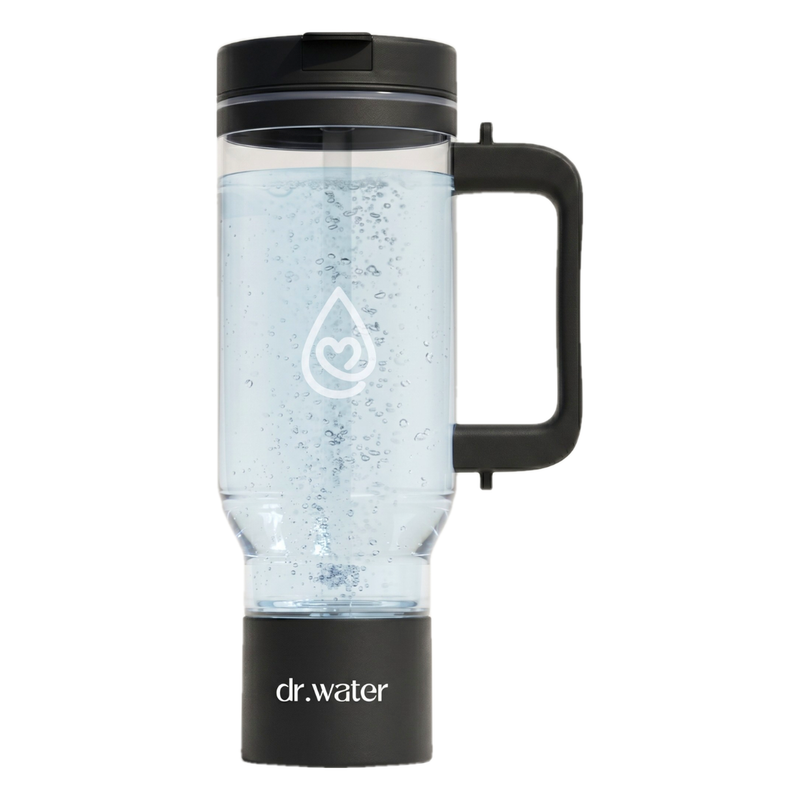
In October 2026 the highest PPB claim I found is 10,000 ppb (10 ppm), listed by the Dr. Water Hydrator Max and by the Holy H2O Hydronizer Infinity. Echo and Nixcer claim up to 8,000 ppb. All of these are maker claims, and a 2026 review puts electrolysis at normal pressure at 0.6 to 1.6 ppm.
Which bottles claim the highest PPB, and at what cycle time
I read each maker's own product page in October 2026 and recorded the top figure and the condition attached to it. "Not stated" means the page did not say. I did not test any bottle.
| Bottle | Highest claim | Condition on the page | Report on the page |
|---|---|---|---|
| Dr. Water Hydrator Max | Up to 10,000 ppb | 10-minute cycle (5 minutes gives about 3,000 ppb) | None linked |
| Holy H2O Hydronizer Infinity | Up to 10 ppm | Not stated in the listing I read | Not checked |
| Echo Flask | Up to 8 ppm | 20-minute cycle (6 ppm at 10 minutes) | H2 Analytics, Jan 2025: up to 8.25 mg/L at 20 min, distilled water |
| Nixcer Pro | Up to 8,000 ppb | 10-minute deep cycle (4,000 ppb at 5 minutes) | None seen |
| Piurify Hydrogenator | Up to 6,300 ppb | Three stacked 10-minute deep cycles | H2 Analytics lists 4.1 mg/L; cycle not stated |
| IonBottles ATOM | Up to 5.0 ppm | 3-minute full cycle | States lab verification; reports per batch |
| Level Up Way flagship | Up to 4,000 ppb | 10-minute cycle (2,000 ppb at 5 minutes) | Not checked |
Dr. Water also lists a Hydrator Pro at 8,000 ppb and a HydroTumbler at 5,000 ppb in its product titles. Sources: each maker's product page, read October 2026. Piurify's own page lists a different model at 8,630 ppb in a comparison chart, which I did not include as a bottle.
The ranking at equal cycle times
A fair ranking uses the same cycle length. On a 10-minute cycle, using each page's own figures, the claims look like this.
| Bottle | Claim at a 10-minute cycle | Page wording |
|---|---|---|
| Dr. Water Hydrator Max | Up to 10,000 ppb | Tap again for 10 min (up to 10,000 ppb) |
| Nixcer Pro | Up to 8,000 ppb | 10-minute deep cycle for maximum output |
| Echo Flask | 6 ppm | 10-minute cycle; 8 ppm needs 20 minutes |
| Piurify Hydrogenator | 4,000 ppb | 10-minute deep mode; higher figures stack cycles |
| Level Up Way flagship | 4,000 ppb | 10-minute cycle |
The order barely moves, but the gaps shrink or grow. Echo's 6 ppm at 10 minutes is a lot closer to the others than its 8 ppm headline suggests.
Why a high number is not the same as a measured number
Four things change what a meter reads. The first is the cycle length. The second is the water. The third is how long the water sat before you measured it. The fourth is the meter.
- A top figure often needs the longest cycle, like Echo's 20 minutes or Nixcer's 10-minute deep mode.
- Echo's report used distilled water. Your tap or filtered water may behave differently.
- Dissolved hydrogen leaves the water over time. Dr. Water's page says it stays strong for about 30 to 60 minutes.
What the physics allows
A 2026 narrative review in the Journal of Clinical Biochemistry and Nutrition states that electrolysis at atmospheric pressure yields dissolved hydrogen of about 0.6 to 1.6 ppm, which is close to the solubility limit at room temperature. It adds that higher values need pressurization, cold water, sealed containers and quick measurement.
The same review says concentrations up to about 3 ppm have been reported under such controlled conditions. Makers claim 5 to 10 ppm, which is above that figure. I cannot confirm any of those claims. I can only tell you to ask each maker for the method behind the number.
Does a higher PPB number mean a better result
Nobody has shown that yet. The studies I cite below did not compare high and low concentrations against each other.
- A 2026 crossover trial in 12 national-level finswimmers used water at 0.9 ppm.
- An 8-week open-label pilot in 20 people used magnesium-stick water at 0.55 to 0.65 mM, which is about 1.1 to 1.3 ppm by my arithmetic.
So a bottle that reaches a higher figure may give you more dissolved gas per glass. Whether that changes any outcome is not known.
Why capacity changes the math
Concentration is only half of the dose. Total dissolved hydrogen is concentration times volume. The table shows illustrative arithmetic, assuming each figure holds. Where a lab figure exists I used it, and otherwise I used the maker's top claim.
| Bottle | Figure used | Volume | Approx. dissolved hydrogen |
|---|---|---|---|
| Dr. Water Hydrator Max | 10 mg/L (claim) | 0.40 L | About 4.0 mg |
| Echo Flask, 20 min | 8.25 mg/L (report) | 0.36 L | About 3.0 mg |
| Echo Flask, 10 min | 6.07 mg/L (report) | 0.36 L | About 2.2 mg |
| Piurify Hydrogenator | 4.1 mg/L (report) | 0.28 L | About 1.1 mg |
This is my arithmetic, not a measurement. It treats 1 ppm as 1 mg per liter and ignores gas lost before you drink. The Hydrator Max row rests on a claim with no linked report, so it is the least certain row.
How to check a high PPB claim yourself
- Find the cycle time attached to the number.
- Look for a report that names the method, such as gas chromatography.
- Test your own water with a method you trust. Our guide to verifying PPB with H2 Blue drops shows one way.
- Test right after the cycle ends, then again at 30 minutes.
For the Hydrator Max, the product page lists about 3,000 ppb at 5 minutes and up to 10,000 ppb at 10 minutes. It does not link a dissolved-hydrogen report. For the math behind these ranges, see our dose-math explainer.
FAQ
Which hydrogen water bottle has the highest PPB?
Among the pages I read in October 2026, the Dr. Water Hydrator Max and the Holy H2O Hydronizer Infinity both claim up to 10 ppm (10,000 ppb). Echo and Nixcer claim up to 8,000 ppb. These are maker claims, not my measurements.
Is a higher PPB hydrogen water bottle better?
A higher figure means more dissolved hydrogen per glass if the claim holds. Research has not shown that more is better, and the trials I cite used water near 1 ppm.
How long does hydrogen last in the water?
Dr. Water's product page says hydrogen stays strong for about 30 to 60 minutes after a cycle and advises drinking within 30 minutes. Other makers publish different retention times.
Can I measure PPB at home?
Yes, with test drops or a meter. A 2025 review in Advanced Science describes gas chromatography, electrochemical sensors and a methylene blue and colloidal platinum method. Each has limits, so note the method when you compare.
Why does the cycle time matter?
Most bottles reach their top figure only on the longest cycle. Echo's 8 ppm needs 20 minutes, and the Hydrator Max reaches up to 10,000 ppb on 10 minutes, per each page.
If you want to read the Hydrator Max specs exactly as we list them, see the Hydrator Max product page.