TLDR
Nafion 117 is a well-known perfluorosulfonic acid membrane family that became the industry reference point for proton exchange separation. It's real, decades-old technology, but no bottle should claim it without proof. What matters for your water is a certified SPE/PEM membrane with proper venting, not a brand name.

In this guide
What is Nafion 117, really?
If you've spent any time reading about hydrogen electrolysis, you've probably run into the term Nafion. It's a perfluorosulfonic acid membrane, first developed by DuPont in the late 1960s, and it became the reference material for proton exchange work across a lot of industries.
The "117" refers to a specific thickness and equivalent-weight spec inside a whole family of similar membranes. It's not one product. It's a naming convention that stuck.
Fuel cell labs, chlor-alkali plants, and electrolyzer manufacturers all cite it because it was one of the first materials to solve a hard problem: how do you let protons cross a barrier while blocking gas and liquid from mixing.
How the membrane sieves protons from gas
Picture a thin plastic sheet with a PTFE-like backbone (the same chemical family as Teflon) studded with sulfonate side chains. Those side chains are hydrophilic. They grab water molecules and cluster together into microscopic channels.
Protons hop through those water-filled channels from one side of the membrane to the other. Everything else, hydrogen gas molecules, oxygen gas molecules, dissolved ions, is too large or too nonpolar to fit through.
The anode and cathode reactions happen on opposite faces of the membrane, physically separated. That's the whole point of a solid polymer electrolyte (SPE) design: the byproduct gases from each side never mix with your water.
Why the industry calls it a gold standard
A few things keep coming up in engineering literature:
- Chemical stability: it holds up under acidic, oxidizing conditions that would degrade cheaper plastics within weeks.
- Proton conductivity: the sulfonate channel structure moves protons efficiently even at room temperature.
- Decades of field data: it's been in commercial fuel cells and electrolyzers since the 1970s, so failure modes are well documented.
That track record is why "Nafion-class" or "PFSA membrane" shows up as the baseline comparison point in almost every technical spec sheet for electrolysis equipment, from industrial hydrogen generators down to countertop water electrolysis units.
What this actually means for your bottle
Nafion is a branded, patented product family from DuPont. It is not automatically what's inside every hydrogen bottle on the market, and you should be skeptical of any product that claims it without a spec sheet to back it up.
What actually matters for your bottle is whether it uses a certified SPE/PEM membrane built on the same proton-exchange principle, with a platinum-plated electrode and a waste-gas vent so chlorine and ozone byproducts are expelled rather than dissolved into your water. That's the standard we hold the Hydrator Max to.
If a bottle maker claims a specific patented membrane without a spec sheet to back it up, treat that as a red flag.
| Feature | Why it matters |
|---|---|
| SPE/PEM membrane | Physically separates anode and cathode gas streams |
| Platinum-plated electrode | Resists corrosion over repeated cycles |
| Waste-gas vent | Chlorine and ozone byproducts exit, not dissolve |
| Borosilicate inner chamber | Handles pressure from gas generation safely |
FAQ
Does the Hydrator Max use DuPont Nafion 117?
No. We use a certified SPE/PEM membrane engineered on the same proton-exchange principle. We don't claim a named supplier's branded material, and you should be wary of any bottle maker who claims a specific patented membrane without documentation.
Is Nafion the only membrane that works for hydrogen electrolysis?
It's the most studied and cited reference point, but it's a family of similar PFSA membranes, not a single unique product. What matters more for a consumer bottle is certification and independent PPB testing, not a brand name.
Why do cheap hydrogen bottles skip a real membrane?
A certified SPE/PEM membrane costs more than a bare plate. Skipping it is cheaper to manufacture, but it removes the physical separation that keeps byproduct gases out of your water.
How can I check what membrane is actually in a bottle I'm considering?
Ask the seller for a spec sheet naming the membrane type and any independent lab testing for dissolved H2 (PPB) and byproduct gas venting. If they can't answer, treat that as a red flag.
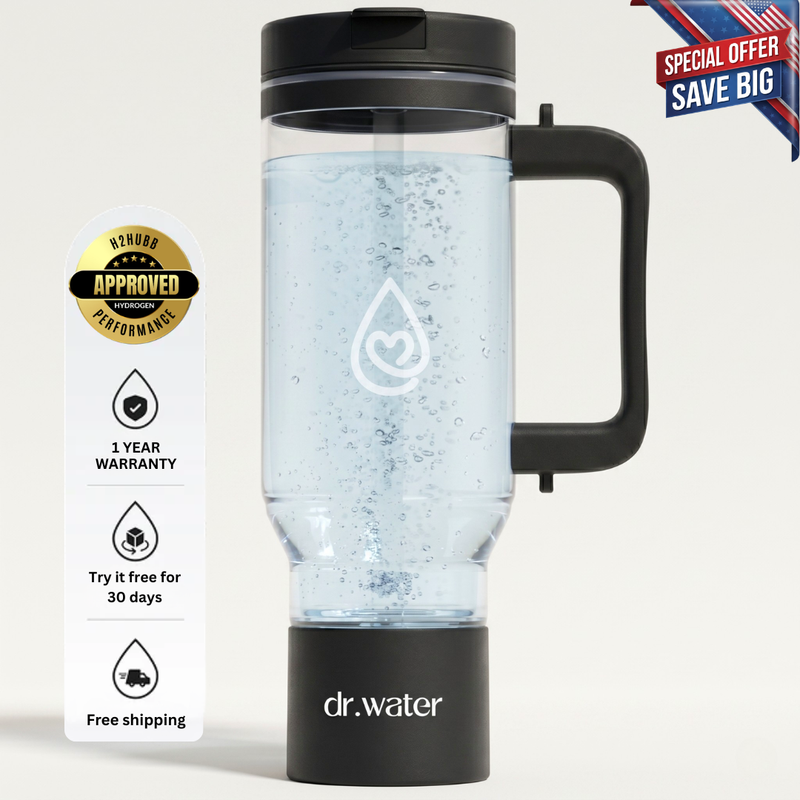
If you want a bottle built around this thinking, the Hydrator Max ships with a certified SPE/PEM membrane, a platinum-plated electrode, and a waste-gas vent, backed by a 30-day risk-free trial. Check it out here.