TLDR
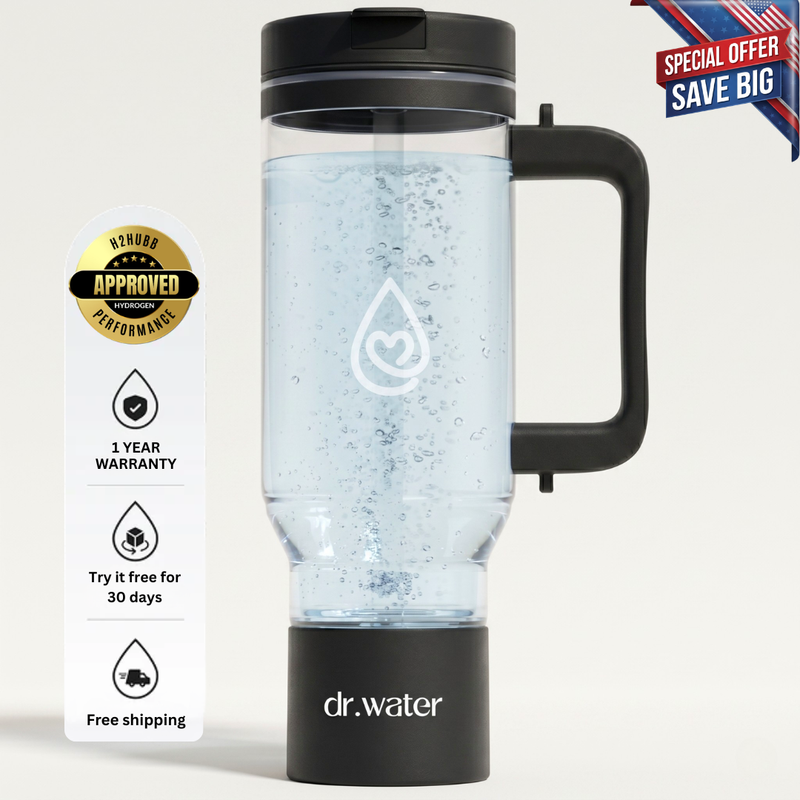
The Hydrator Max's pressurized borosilicate chamber is built around Henry's Law, keeping dissolved hydrogen sealed under pressure so it reaches a peak of 10,000 PPB (10 ppm) instead of outgassing before you drink. Qcup Max claims up to 3,000 PPB per 5-minute cycle, 5,000 PPB across two cycles, but does not publish how their chamber seals or holds pressure (their site, Aug 2026). Here's what Henry's Law actually means for a hydrogen bottle.

Henry's Law in plain English
Henry's Law says that the amount of gas that stays dissolved in a liquid depends on the pressure above it. More pressure, more gas stays dissolved. Less pressure, gas escapes as bubbles.
You have already seen this in action if you have ever opened a soda bottle. It fizzes because the pressure holding carbon dioxide in solution just dropped. Hydrogen behaves the same way inside a bottle's chamber.
For a hydrogen bottle, the seal and the chamber pressure are not there to just keep water from spilling. They are doing real work, holding hydrogen in solution until you drink it.
How pressure sealing affects your ppb reading
This is the part of the spec sheet most listings skip entirely. A bottle can run a strong electrode and still under-deliver on the meter if the chamber cannot hold pressure once electrolysis is done.
| Chamber Condition | Effect on Dissolved H2 |
|---|---|
| Sealed, pressurized chamber | Holds gas in solution, supports a higher peak reading |
| Loose or low-pressure seal | Gas escapes faster, peak reading drops sooner |
| Measured right after a cycle | Reading is at its highest right after the cycle finishes |
| Left open or sipped slowly over hours | Reading drops over time as gas outgasses |
A bottle can run a strong electrode and still under-deliver on the meter if the chamber cannot hold pressure.
Our verified peak number
This is where the physics and the spec sheet meet. Everything above explains why the number exists, this is the number itself.
The Hydrator Max is built around a pressurized borosilicate glass chamber specifically to make the most of Henry's Law. That design is a direct part of how we reach and measure 10,000 PPB (10 ppm) on-device, not a separate claim bolted on afterward.
Qcup Max publishes a peak ppb figure, up to 3,000 PPB per 5-minute cycle and 5,000 PPB across two cycles, but does not describe how their chamber seals or holds pressure (their site, Aug 2026); we can only verify our own build. Qlife publishes this on qlifetoday.com, retrieved August 2026; specs change, so their page is the source of truth.
What to check on any bottle's seal
None of this requires a chemistry background to evaluate. It just requires asking the question that most listings skip past.
- Does the listing mention a pressurized chamber, or just a "sealed lid"
- Is the ppb figure measured right after a cycle, or under unclear conditions
- Does the chamber material resist gas permeability over time
- Is there a warranty if the seal fails
Run Qcup Max, or any bottle you are comparing, through that list before you decide based on price or packaging alone.
FAQ
What is Henry's Law and why does it matter for hydrogen water?
It describes how gas stays dissolved in a liquid under pressure. A hydrogen bottle's seal and chamber pressure directly affect how much dissolved hydrogen survives until you actually drink it, not just how much was produced during the cycle.
Does the Hydrator Max's seal affect the 10,000 PPB reading?
Yes. The pressurized borosilicate chamber is designed to hold dissolved hydrogen in solution, which is part of how the peak reading is reached and measured on-device.
How does Qcup Max's sealing compare to the Hydrator Max?
We can only verify our own build. Qcup Max claims up to 3,000-5,000 PPB depending on cycle count, but their site does not describe chamber pressure or sealing mechanism as of Aug 2026.
What water should I use in the Hydrator Max?
RO, distilled, or filtered water. Do not electrolyze water with added salts or powders, mix those in after the cycle finishes.
Want to feel the pressurized seal in action for yourself? Try the Hydrator Max for 30 days, risk-free, and see what it reads on your own meter.
⚕️ Clinicians' Choice
2,033 clinicians share Dr. Water on VerifiedMD without compensation.