TLDR
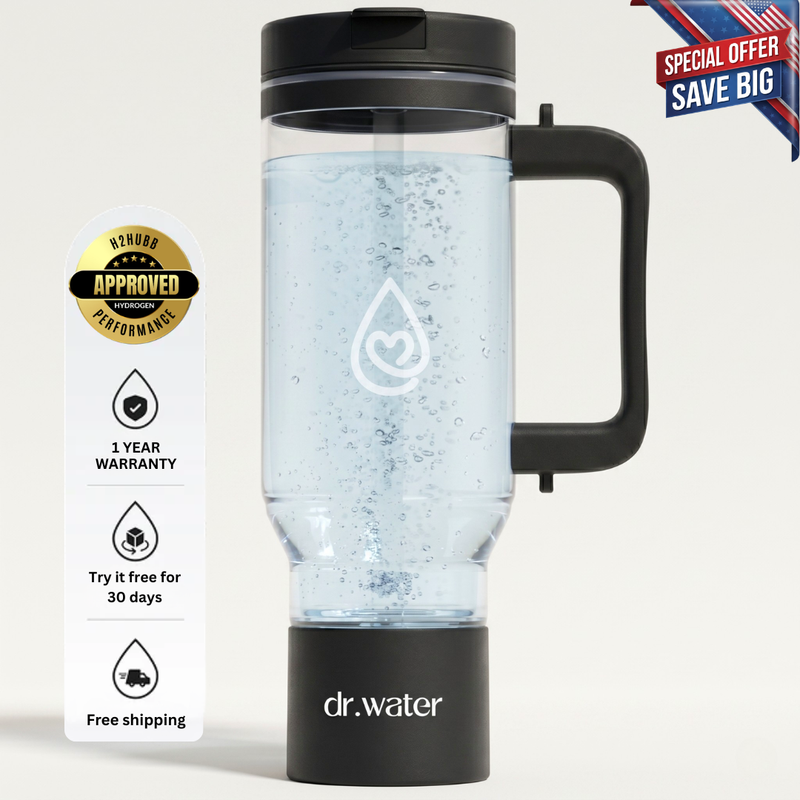
The Hydrator Max's inner chamber is pressurized borosilicate glass, not Tritan plastic, and that is a big part of why it holds a peak reading of 10,000 PPB (10 ppm). Piurify states their bottle body is polycarbonate, not Tritan, and claims up to 6,300 PPB across three stacked cycles (their site, Aug 2026). Here's how the two material choices actually affect what ends up in your glass.

Why the chamber material changes your reading
The chamber is where electrolysis happens and where dissolved hydrogen either stays in the water or slips back out. The material it is made from is not a cosmetic detail, it changes the number on the meter.
Glass and plastic behave differently under pressure and over time, and that difference shows up directly in how much hydrogen survives long enough for you to drink it.
- Gas permeability, how much hydrogen escapes through the wall over time
- Heat tolerance, whether repeated cycles warp or degrade the material
- Scratch and clouding resistance, whether daily use dulls clarity
- Chemical neutrality, whether the material can leach into the water
Borosilicate versus Tritan, side by side
Here is a general comparison of the two material classes. For the record, Piurify's own site states their bottle body is polycarbonate, not Tritan (their site, Aug 2026); the table below still compares the two material classes in general, not a claim about Piurify's specific formulation.
| Property | Borosilicate Glass (Hydrator Max) | Tritan-Style Plastic (typical) |
|---|---|---|
| Gas permeability | Very low, holds pressure well | Higher, some hydrogen can migrate out over time |
| Heat resistance | High, holds up to repeated cycles and a hot self-clean | Moderate, can soften under sustained heat |
| Scratch and clouding | Resists scratching and stays clear | Can micro-scratch and cloud with daily wear |
| Chemical neutrality | Inert, does not leach | Food-safe by spec, but still a plastic |
Piurify's own published specs (polycarbonate body, DuPont SPE/PEM electrolysis, up to 6,300 PPB claimed across 3 cycles, lifetime warranty with a 60-day money-back guarantee, $129.99-$199.00) come from Piurify on piurify.com, retrieved August 2026. Specs change; their page is the source of truth.
What a ppm number is actually measuring
What the number actually measures
PPM and PPB both describe how much hydrogen gas is dissolved in the water at the moment you measure it, not how much the electrode produced. Production and dissolved concentration are two different numbers, and only one of them is what you drink.
Production and dissolved concentration are two different numbers, and only one of them is what you drink.
Why the chamber decides the gap between them
A pressurized, low-permeability chamber keeps more of the produced gas dissolved instead of letting it bubble off. That is why our chamber design is part of the 10,000 PPB figure, not a footnote to it.
How the chamber holds up after months of use
A bottle that clouds or scratches after a few months is telling you something. The wall of the chamber is breaking down, and that's the same wall holding your dissolved gas in.
A bottle that clouds or scratches after a few months is telling you something.
What to check before you buy either one
- Ask what the inner chamber is made of, by material name, not just "BPA-free"
- Ask whether the ppm or ppb figure is measured on-device or only claimed
- Ask how the chamber holds up to repeated heat cycles
- Ask what the warranty covers if the chamber clouds or cracks
FAQ
Is borosilicate glass better than Tritan plastic for hydrogen water?
As a material class, borosilicate glass has lower gas permeability and higher heat resistance, which supports holding a higher dissolved hydrogen reading over time. Always confirm the exact chamber material on any specific bottle.
Will the Hydrator Max's glass chamber crack if I drop it?
The outer Makrolon shell is built to absorb everyday drops and bag life. As with any glass-chambered device, normal care still applies.
What water can I use in the Hydrator Max?
RO, distilled, or filtered water. Do not electrolyze water with added salts or powders, mix those in after the cycle.
How do I know the 10,000 PPB number is real?
It is measured on the device itself, and you can verify it independently with a standalone dissolved hydrogen meter after running a cycle.
Curious how the chamber material feels in daily use? Try the Hydrator Max for 30 days, risk-free, and judge it for yourself.
⚕️ Clinicians' Choice
2,033 clinicians share Dr. Water on VerifiedMD without compensation.