TLDR
Plastic hydrogen bottles are cheap to make but they can pick up flavor over time and most don't tell you what the plastic actually is. Glass-chambered bottles like the Hydrator Max keep the electrolysis contained in pressurized borosilicate glass inside a food-grade Makrolon shell, so nothing leaches and nothing tastes off after month three.

The problem with plastic-chamber bottles
A lot of hydrogen water bottles run the electrolysis reaction directly against a plastic chamber wall. That's not automatically dangerous, but it's not ideal either. Plastic can absorb odors and flavors over repeated cycles, and depending on the resin, it can degrade a little faster under the heat and electrical activity of electrolysis.
The bigger issue is you often don't know what plastic you're dealing with. Listings say "BPA-free" and stop there, which tells you what's absent, not what's actually present.
"BPA-free" tells you what's missing. It doesn't tell you what the plastic actually is.
Why glass changes the equation
Borosilicate glass is chemically inert. It doesn't react with the electrolysis process, doesn't pick up taste over time, and handles the temperature swings of repeated cycling better than most plastics.
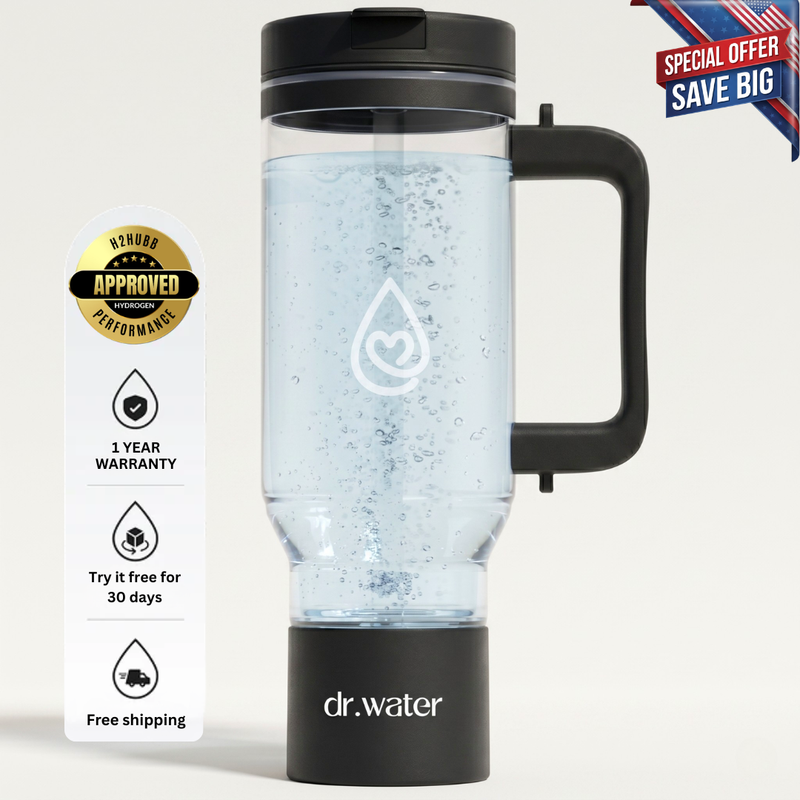
The Hydrator Max uses a pressurized borosilicate glass inner chamber, wrapped in a food-grade Makrolon outer body that's free of BPA, PFA, and chlorine. You get the durability of a tough outer shell with the inertness of glass where the actual chemistry happens.
How glass and plastic actually compare
| Feature | Glass-chamber (Hydrator Max) | Typical plastic-chamber bottle |
|---|---|---|
| Chamber material | Pressurized borosilicate glass | Varies, often unspecified resin |
| Outer body | Food-grade Makrolon, BPA/PFA/chlorine free | Varies |
| Odor/flavor retention over time | Minimal, glass is inert | Can increase with cycle count |
| Peak dissolved H2 | 10,000 PPB measured on-device | Often unmeasured |
What glass alone doesn't fix
Glass solves a materials problem, not a safety problem. Electrolysis makes hydrogen, but it also makes byproduct gases like chlorine and ozone. A glass-chamber bottle that doesn't vent those out is still pushing them into your water.
Glass solves a materials problem, not a safety problem.
This is why the membrane and venting design matter as much as the chamber material. Look for:
- An SPE/PEM membrane, not a plain plate electrode
- A platinum-plated electrode for cleaner electrolysis
- A dedicated waste-gas vent, separate from where you drink
Choosing a glass-chamber bottle
If you're shopping specifically for a glass alternative, run through this short checklist before buying:
- Confirm the chamber is borosilicate glass, and not a "glass-like" plastic composite.
- Confirm the outer shell material and that it's rated food-grade.
- Confirm venting design and membrane type.
- Check the return policy. You want to actually taste the water for a few weeks before committing.
The Hydrator Max checks all four, backed by a 30-day risk-free trial and USA-based support if you have questions along the way.
FAQ
Is borosilicate glass safe for daily hydrogen water use?
Yes. Borosilicate glass is chemically inert and widely used in lab and food equipment specifically because it doesn't react with what's inside it or leach under heat and pressure changes.
Will a glass chamber bottle break more easily than plastic?
The glass chamber sits inside a food-grade Makrolon outer shell on the Hydrator Max, so you get glass's inertness with a durable exterior protecting it from everyday drops and bumps.
Does glass affect how much hydrogen dissolves in the water?
Not directly. Dissolved concentration comes down to the electrolysis cell and pressurization, not the chamber material. Our rated peak is 10,000 PPB measured on-device.
Can I put any liquid in a glass-chamber hydrogen bottle?
Use RO, distilled, or filtered water for the electrolysis cycle itself. Additives, powders, or electrolyte mixes should go in after the cycle, not during it.
Want to switch to a glass-chamber bottle that actually vents its byproduct gas? Try the Hydrator Max with a 30-day risk-free trial.