Quick Summary
- Hydrogen water bottles don’t “run out” of hydrogen, but hydrogen gas naturally dissipates over time.
- What really matters is the bottle’s generator lifespan, not the hydrogen in the water.
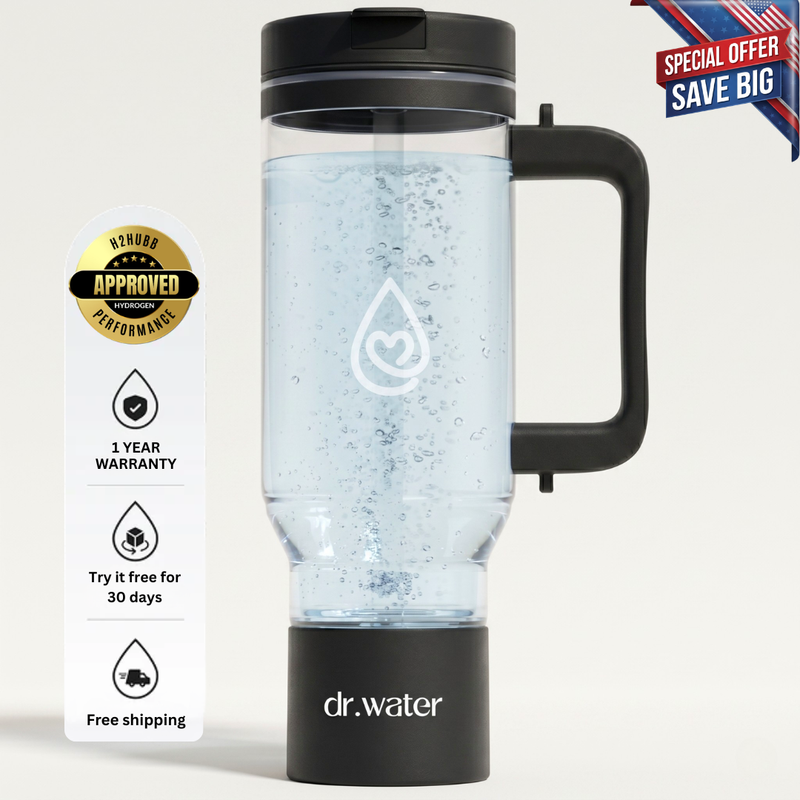
- Most quality bottles, like Dr. Water’s Portable Hydrogen Bottle, last several years with proper care.
- Learn how hydrogen bottles work, what affects their longevity, and how to extend their life below.
Hydrogen water bottles are tiny water science labs designed to infuse your drink with molecular hydrogen (H₂), a naturally occurring antioxidant.
When you power on the bottle, it activates a process called electrolysis, where a small electric current passes through water (H₂O) to separate it into hydrogen and oxygen. The hydrogen gas produced dissolves directly into your drinking water.
What makes high-quality bottles stand out is the use of dual-layer PEM and SPE membranes, the same advanced materials found in medical and aerospace-grade filtration systems. These membranes ensure that:
- Only pure hydrogen gas enters the water, while oxygen and ozone are safely vented out.
- The process is chemical-free and odorless, preserving the natural taste of water.
- Hydrogen concentration remains consistently high with every cycle.
So rather than storing hydrogen, the bottle creates it fresh each time you press start—delivering clean, functional hydration that supports better energy, recovery, and cellular health.
So… Do Hydrogen Water Bottles Run Out of Hydrogen?

Not exactly. A hydrogen water bottle doesn’t run out of hydrogen; it simply produces hydrogen that eventually escapes from the water over time.
Hydrogen is the lightest and smallest molecule in the universe, which means it’s highly mobile. Once dissolved, it slowly diffuses through air, bottle caps, and even some plastics. That’s why hydrogen water is best enjoyed soon after it’s made while the gas concentration is at its peak.
Freshly generated hydrogen water keeps its potency for around 1–2 hours if the bottle is sealed. Leaving it open or stirring accelerates hydrogen loss, sometimes within minutes.
No problem if it dissipates, the bottle’s generator can simply create a new, freshly infused batch anytime. Your bottle is designed to recreate it on demand, giving you fresh hydrogen-rich water whenever you need it.
How Long Does Hydrogen Stay in Your Water?
Hydrogen gas is highly volatile, so its concentration in water changes based on:
- Storage: Seal your bottle right after generation. Exposure to air allows hydrogen to escape quickly.
- Temperature: Cold water holds hydrogen longer. Warm or hot water accelerates gas loss.
- Material quality: Bottles made with Tritan or borosilicate glass preserve hydrogen more effectively than basic plastics.
Typical retention times:
|
Condition |
Approximate Hydrogen Retention |
|
Sealed at room temperature |
1–2 hours |
|
Refrigerated (sealed) |
Up to 3 hours |
|
Open bottle |
10–15 minutes |
Pro tip: For maximum benefit, drink your hydrogen water immediately after generation, that’s when hydrogen concentration is at its highest and most active.
Do You Have to Replace Hydrogen Water Bottles?
Eventually, yes, but only after years of regular use.
Hydrogen water bottles are powered by a combination of electrodes, PEM/SPE membranes, and rechargeable batteries. Each of these components plays a role in generating pure molecular hydrogen, and, like any precision device, they have natural lifespans.
Here’s a quick breakdown:
- Electrode plates: Typically last 2–3 years, depending on water quality and frequency of use.
- PEM/SPE membrane: Can perform efficiently for 3–5 years when cleaned and descaled regularly.
- Rechargeable battery: Delivers around 300–500 charge cycles, translating to years of daily use.
With basic maintenance, like rinsing after use and monthly descaling, a high-quality hydrogen bottle can easily last three years or longer before showing any signs of reduced performance.
In short, you don’t replace a hydrogen bottle often; you simply care for it like a smart hydration device built to last.
Read: Alternatives to Bottled Water That Solve Specific Daily Problems
Signs It Might Be Time for a Replacement
Like any smart device, your hydrogen water bottle gives subtle signs when it’s due for a refresh or quick maintenance. Paying attention early can often save you from a full replacement.
Here’s what to watch for:

- Weaker hydrogen bubbles: If the usual fizzing slows down or stops, the electrodes or membrane may need cleaning.
- Shorter run time per charge: Battery efficiency can drop over time or with frequent use.
- Metallic smell or residue: Mineral buildup or scale inside the chamber signals it’s time to descale.
- Warning lights or charging issues: These may point to loose connections or worn battery contacts.
In most cases, these signs mean your bottle simply needs a deep clean, membrane rinse, or cell replacement, not a brand-new device. A little upkeep can extend its life for years.
Also Read: Best Hydrogen Water Bottle for Daily Use
Pro Care Routine
A few simple habits can help your hydrogen water bottle last longer and keep producing optimal hydrogen levels.

1. Rinse after every use
Quickly rinse the bottle and generator chamber with clean water to prevent mineral buildup and residue. Avoid using harsh detergents.
2. Deep clean weekly
Use a mild citric acid or vinegar solution once a week to dissolve scale from electrodes and membranes. Rinse thoroughly before the next use.
3. Recharge regularly
Keep your battery between 20%–80% charge to extend its lifespan. Avoid letting it fully discharge for long periods.
Consistent maintenance not only keeps your water tasting pure, it also helps your bottle deliver stronger, more stable hydrogen generation for years.
When it comes to hydrogen water bottles, not all technology is created equal. Many budget options use lower-grade membranes or unsealed electrodes, which degrade faster and produce inconsistent hydrogen levels over time.
That’s exactly where Dr. Water makes a difference, offering reliability and purity that stay strong long after others fade.
Why Dr. Water Bottles Last Longer

Dr. Water combines medical-grade engineering with a focus on durability and sustainability. Each bottle is designed to last for years, not months, delivering consistent hydrogen performance with minimal maintenance.
Here’s what makes the difference:
- Advanced PEM + SPE Membranes: The same high-efficiency technology used in hospital-grade hydrogen generators ensures long-term stability and purity.
- High-Capacity Rechargeable Battery: Built for hundreds of charge cycles, keeping your bottle powered for daily use.
- Carbon-Neutral Design: Every product offsets its production footprint, aligning hydration with sustainability.
- Premium, BPA-Free Materials: Made with certified Tritan and borosilicate glass that preserve hydrogen longer and resist wear.
- 3-Year Extended Warranty: Proof of confidence in performance and product quality.
Dr. Water bottles are designed as long-term wellness investments, built to perform reliably while supporting a cleaner planet.
Experience hydration that works smarter, lasts longer, and supports your wellness journey.
Shop Dr. Water Portable Hydrogen Bottles
Wrapping Up
Hydrogen water bottles don’t really run out of hydrogen; they generate it on demand. What determines their performance isn’t the hydrogen itself, but the technology, materials, and care behind the device.
With advanced PEM + SPE membranes, durable construction, and a 3-year extended warranty, Dr. Water sets the benchmark for reliability and longevity in hydrogen hydration. Every cycle delivers clean, functional water that supports better energy, recovery, and daily wellness, all while aligning with your eco-conscious lifestyle. ShopNow.
FAQs
1. How long does hydrogen stay in water after generation?
Hydrogen remains dissolved for about 1–2 hours in a sealed container. Once opened or agitated, it starts to escape quickly. For best results, drink your hydrogen water immediately after generation while the hydrogen concentration is highest.
2. Can hydrogen water bottles stop producing hydrogen?
Yes, but only if the electrode plates or PEM/SPE membrane begin to wear out or become clogged with mineral buildup. Regular cleaning and descaling usually restore full performance and prevent early failure.
3. Do you have to replace hydrogen water bottles entirely?
Not necessarily. Most performance issues come from scale buildup or worn components, not the entire device. Premium bottles like Dr. Water’s Portable Hydrogen Bottle are designed for long-term use and can perform efficiently for years with proper care.
4. Is hydrogen water safe to drink every day?
Absolutely. When produced with NSF- and FDA-certified materials and clean water sources, hydrogen water is safe for daily hydration and general wellness support. It’s free of chemicals or additives, just pure water enhanced with molecular hydrogen.
5. What’s the best way to maintain a hydrogen water bottle?
Rinse your bottle after each use, descale monthly using a mild citric acid solution, and avoid hard water buildup. Keeping the electrodes and membranes clean ensures stronger hydrogen production and extends the bottle’s lifespan.