|
Key Takeaways
|
Every cell in the human body depends on efficient hydration to produce energy, repair tissue, and remove waste. But emerging research shows that even when we drink plenty of water, the body’s ability to use it effectively can be disrupted by oxidative stress, a buildup of reactive oxygen species that interferes with cellular communication and recovery.
Over the past few years, scientists have explored whether molecular hydrogen (H₂), a microscopic, selective antioxidant gas, can help restore that balance. In a 2024 controlled trial published in Frontiers in Physiology, athletes who drank hydrogen-rich water for just eight days showed measurable improvements in power output and total repetitions compared to those consuming regular water.
This blog will cover what hydrogen water really is, how it interacts with pH, and alkalinity.
What Is “Water of Hydrogen” (Hydrogen Water)?
Hydrogen water, also called hydrogen-rich water (HRW) or water of hydrogen, refers to water (H₂O) that has been enriched with molecular hydrogen (H₂) gas. Unlike minerals that ionize water to increase alkalinity, H₂ is a neutral, nonpolar molecule.
It dissolves in water but does not ionize or shift the water’s pH significantly. Its primary function is not to alkalize but to act at the molecular and cellular level as an antioxidant and signaling modulator.
How Hydrogen Water Is Made
There are a few common production methods used commercially and in research

-
Electrolysis (Electrolyzed Hydrogen Water, EHW): An electric current splits water into hydrogen and oxygen; special membranes allow H₂ gas to be dissolved. This is one of the most common consumer-grade methods for hydrogen infusion.
-
Gas Infusion / Bubbling Under Pressure: Pure H₂ gas is bubbled into water under high pressure, increasing solubility and achieving supersaturation.
- Tablets / Chemical Reaction (e.g., magnesium + acid reactions): Some hydrogen water products use tablets or cartridges that react (e.g., alloy or magnesium-based) to release H₂ gas inside the water container.
Each method has tradeoffs in terms of maximum concentration (ppm or ppb), retention time, and cost. Importantly, once hydrogen is dissolved, it tends to escape (outgas) over time, especially in open or permeable containers.
Key Properties & Behavior of Molecular Hydrogen in Water
- Neutrality: H₂ is chemically inert in terms of acidity/alkalinity, so it won’t shift pH substantially.
- Selectivity: Studies suggest molecular hydrogen selectively neutralizes the most toxic reactive oxygen species .
- Safety profile: H₂ is considered safe for oral consumption. A 2023 review covering over 80 clinical trials of molecular hydrogen therapies found that serious adverse effects are rare.
- Dissolution & retention: Because H₂ is a small, mobile molecule, its concentration in water gradually declines.
Suggested Read: The Science of Hydrogen Water and Everything You Need to Know About It
The pH of Hydrogen Water. Does It Matter?
A frequent misconception about hydrogen water is that it must be “alkaline.” In reality, hydrogen concentration and pH are two different properties that do not necessarily correlate.
Understanding the Difference
The pH scale measures how acidic or basic a solution is, ranging from 0 (acidic) to 14 (alkaline), with 7 considered neutral. Hydrogen water typically has a neutral pH around 7, unless minerals or additives are intentionally introduced to alter it.
The “hydrogen” in hydrogen water refers not to hydrogen ions (which define acidity or alkalinity), but to dissolved molecular hydrogen gas (H₂), a neutral molecule.
Hydrogen Water vs. Alkaline Water: What’s the Difference?
Many consumers still use “hydrogen” and “alkaline” water interchangeably. The truth is that they operate on entirely different mechanisms.

If you’re choosing between “alkaline” and “hydrogen” water, focus on molecular hydrogen concentration (ppm or ppb), not the pH label. A higher hydrogen concentration, typically 1–6 parts per million (ppm), correlates with stronger redox potential and cellular benefits, while the pH may remain neutral.
By understanding this distinction, you can avoid marketing confusion and make decisions based on measurable science, not just alkalinity claims.
Research-Backed Health Benefits of Hydrogen Water
Molecular hydrogen (H₂) is the element that gives hydrogen water its purported health effects, and unlike many wellness claims, a growing body of peer-reviewed research supports measurable benefits in humans and animals.

Clinical and translational studies since then have examined antioxidant, metabolic, and recovery outcomes:
1. Muscle Recovery in Elite Swimmers (2024)
In a randomized, double-blind, placebo-controlled crossover trial, elite fin swimmers consumed HRW over 4 days during two strenuous training sessions. The HRW group showed lower blood creatine kinase (CK) levels, reduced perceived muscle soreness, and improved countermovement jump performance at 12 hours post-exercise compared to placebo.
2. Lipid / Cholesterol Reduction (2024 Meta-Analysis)
A systematic review and meta-analysis of randomized controlled trials published through January 2024 found that HRW supplementation was associated with significant reductions in total cholesterol (TC), low-density lipoprotein (LDL), and triglyceride (TG) levels in metabolic disorder populations. However, changes in high-density lipoprotein (HDL) were non-significant.
3. Muscular Endurance in Trained Individuals (2024)
A training study over 8 days in already trained subjects found HRW supplementation significantly enhanced muscular endurance, though it did not significantly speed fatigue recovery.
4. Fatigue, Endurance & Musculoskeletal Function (2024)
In a 14-day randomized controlled trial, HRW consumption improved fatigue severity score, 6-minute walk test distance, and musculoskeletal function scores in participants relative to placebo.
5. NAFLD / Metabolic Effects (2025 review)
A new systematic review (2025) highlights an eight-week double-blind RCT in subjects with non-alcoholic fatty liver disease (NAFLD). It reported that HRW significantly reduced BMI and body weight and improved lipid profiles.
6. Hydrogen Water + Heart Rate Variability (2025 pilot)
A pilot 8-week randomized trial combined HRW with heart-rate variability biofeedback; early indications suggest improvements in autonomic regulation, though results are exploratory.
7. Chronic Dialysis & Kidney Function (2024 Review)
A 2024 systematic review titled “Hydrogen Water: Extra Healthy or a Hoax?” discusses studies in chronic dialysis patients, citing results where electrolyzed hydrogen water (EHW) intake improved markers such as blood urea nitrogen (BUN) and renal function parameters.
Hydrogen water is Generally Recognized as Safe (GRAS) by the FDA. As with any functional beverage, moderation is key. Aim for 16–20 oz once or twice daily unless your healthcare provider suggests otherwise.
Suggested Read: Hydrogen Water's Role in Improving Glycemic Control and Diabetes
Dr. Water: The Science-Backed Solution
As studies highlight the real benefits of hydrogen water, Dr. Water leads with advanced SPE-PEM technology that keeps pH balanced and hydrogen levels high, delivering clean, effective, and sustainable hydration.
1. Dr. Water Hydrator Pro - 6ppm Hydrogen Water Bottle

For those who demand both performance and portability, the Dr. Water Hydrator Pro stands out as a compact powerhouse.
Using advanced SPE/PEM N117 membrane technology, it produces between 3,500 and 6,000 ppb of dissolved molecular hydrogen in under 5 minutes, one of the highest achievable concentrations in a consumer-grade bottle.
Key Technical Strengths:
- Built with Makrolon™ and military-grade aluminum oxide, the bottle resists heat and impact.
- Includes an LCD timer, dual-cycle operation (5 or 10 minutes), and a USB-C rechargeable battery for on-the-go use.
Design & Assurance:
- Capacity: 9.5 oz (280 ml)
- Weight: 0.77 lb (350 g)
- Warranty: 3 Years + 60-Day Money-Back Guarantee
- Sustainability: Carbon-neutral certified production
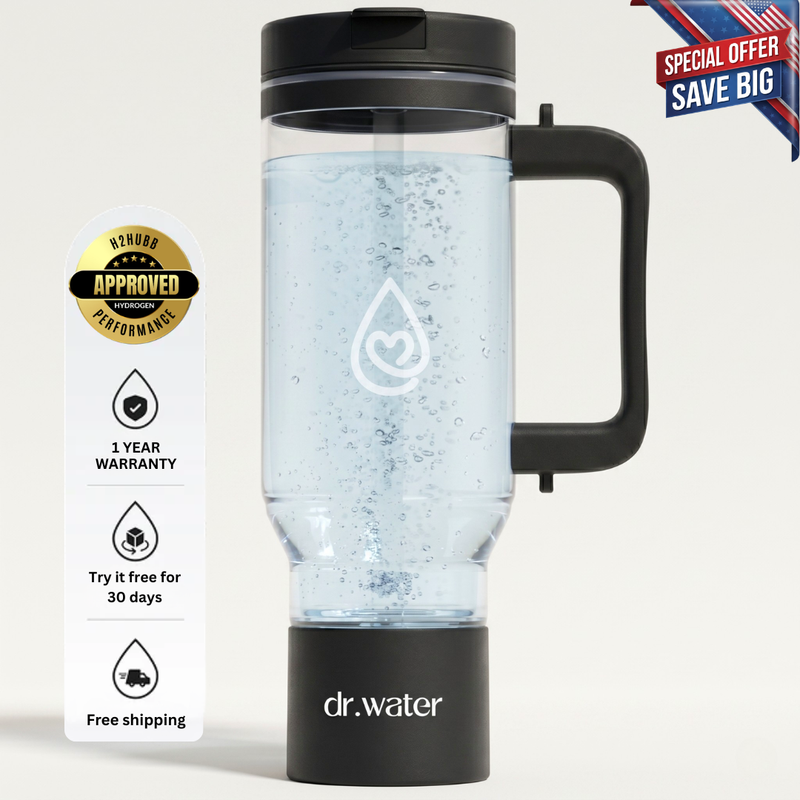
2. Dr. Water HydroStanley 32oz – Premium Hydrogen Water Bottle

For those who see hydration as a lifestyle, not a routine, the HydroStanley 32 oz offers practicality, longevity, and sustainability in one elegant package. Designed for daily use, it retains Dr. Water’s scientific rigor while maximizing convenience for larger hydration needs.
Key Features:
- Product Dimension: 10.4″L × 3.7″W × 5.5″H
- Hydration Technology: Nano Electrolysis Ionizer (SPE-PEM)
- PPB (Parts Per Billion): Up to 3000 PPB in 10 minutes
- Power: 4000 mAh Battery, Type-C rechargeable (3–4 h charging)
- Battery Lasts: ~50 hydrogenations (7–10 days per charge)
- Capacity: 32 oz (≈ 1 liter)
- Weight: 1.28 lbs
- Body Material: High-Grade, BPA-Free Materials
- Warranty: 1 Year Limited Warranty
Dr. Water’s solutions are optimized for better hydration, with scientifically-backed benefits that promote enhanced wellness and support a healthier, more active lifestyle.
Wrapping Up
So, what makes hydrogen water worth the attention? It’s simple; it helps your body feel and function better from the inside out. With its powerful antioxidant properties, hydrogen-infused water supports recovery, focus, and overall wellness without changing your daily routine.
With Dr. Water’s solutions, you can replenish electrolytes, support muscle recovery, and reduce oxidative stress, making them the ideal addition to your fitness and wellness routine.
Shop Dr. Water today and experience the health benefits of hydrogen-rich water firsthand.
FAQs
1. Is hydrogen water the same as alkaline water?
No. Hydrogen water contains molecular hydrogen gas (H₂) dissolved in neutral pH water, while alkaline water alters pH by adding minerals.
2. Does hydrogen water change your body’s pH?
No. Studies confirm that hydrogen-rich water does not alter blood or tissue pH. Its benefits come from redox balance, neutralizing free radicals and supporting mitochondrial function, not from pH modification.
3. How much hydrogen water should I drink daily?
Ideally, use 300–600 ml per day (10–20 oz), consumed within 15–30 minutes of generation to retain optimal hydrogen levels. With larger bottles like HydroStanley (32 oz), one or two servings daily cover that range easily.
4. Is hydrogen water safe for long-term use?
Yes. Hydrogen gas is officially FDA-recognized as GRAS (Generally Recognized as Safe).